Pools in Greater Boston live short, busy lives. A backyard pool in Wellesley, Sudbury or Easton might run from late May to early September, sit under a cover through a winter of snow and freezing nights, and come back green in spring. A good pool service company handles that whole cycle. Before you hire one, it helps to know what the state regulates around the pool, even though it does not license the person cleaning it.
What does Massachusetts require of the fence around your pool?
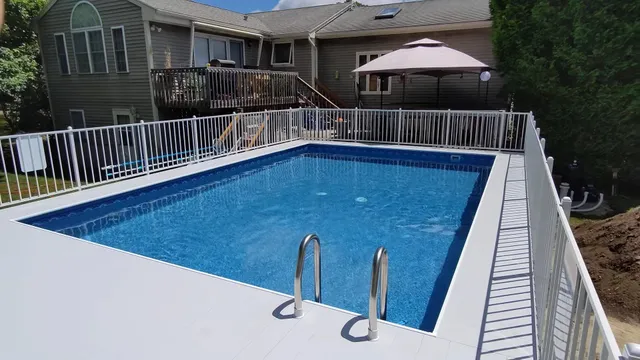
The pool barrier is the one part of a residential pool the state building code spells out in detail. The relevant section is 780 CMR 3109.4. Once the water can be deeper than 24 inches, the pool must be enclosed by a barrier no lower than 48 inches, and every gate in it has to swing shut and latch without anyone's help. That applies to above-ground pools that deep as well as in-ground ones.
Your town's building department enforces the rule, usually through the pool permit. Many towns publish their own checklists; Belmont's swimming pool permit guide is a clear example of what a building department asks for. In Lexington, Needham or Andover the details and forms differ, so ask your own office.
Why does this matter when you hire a pool service? Because the service crew is at your pool every week and will notice what you stop seeing: a gate that no longer swings shut, a latch that sticks, a chair left against the fence, a gap under the fence where the ground has washed out. Ask your service company to check the gate and barrier on every visit and tell you about problems in writing. A barrier that fails to close is a drowning risk for a neighbor's child, not just a code issue.
Who is allowed to wire the pump, heater and lights?
Pool cleaning needs no state license. Pool electrical work does. Pumps, heaters, heat-pump pool heaters, lights and bonding are wiring jobs for a licensed electrician, under a wiring permit from your town. The Board of State Examiners of Electricians licenses electricians, and you can look any one up yourself on the state's eLIPSE portal.
A pool service technician can usually swap a pump motor on an existing plug-in or replace a cartridge. Running a new circuit, moving a pump to a new location, adding a heater or fixing a tripping breaker is different. Ask the service company what electrical work they do themselves and which electrician they call for the rest. Water and electricity together are the reason the line matters.
If the heater runs on gas, the gas line is separate licensed work for a gas fitter or plumber.
Opening and closing around a short season
The pool season around here runs roughly Memorial Day to Labor Day. That makes two dates the busiest of the year for pool companies: the spring opening and the autumn closing.
Openings. Book in early spring. A typical opening removes and cleans the cover, reconnects the pump and filter, restarts the system, and balances the water. A pool that sat badly covered may need a green-to-clean recovery, which costs more and takes several visits.
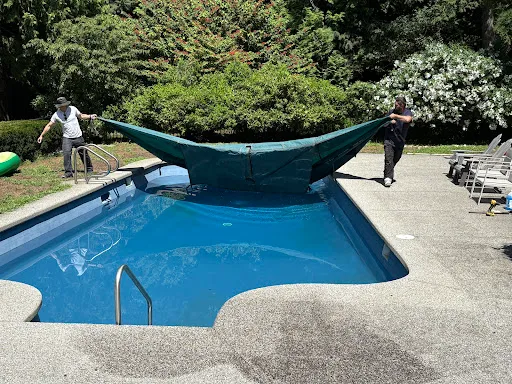
Closings. A proper closing protects the lines and equipment from freezing. It usually includes lowering the water, blowing out and plugging the lines, adding winter chemicals, winterizing the pump, filter and heater, and fitting the cover. Ask whether the company checks the cover during winter, and whether a mid-winter visit is included or extra. A cover sagging under wet snow is common in a heavy winter.
Weekly service: what is in the visit?
Weekly service plans vary a lot. Ask each company what a visit includes:
- skimming, brushing and vacuuming,
- emptying baskets and checking the filter pressure,
- testing and adjusting the water chemistry, and
- a written or app log of readings and chemicals added.
Ask whether chemicals are included in the price or billed separately, and what happens after a storm drops leaves and debris into the pool. Salt pools and pools with automatic covers or heaters need someone who knows that equipment.
The calculator default for a typical Greater Boston pool service visit is about $280 to $550; the Greater Boston pool service cost estimate shows the market range. Openings, closings and recovery visits sit at or above the top.
Covers, snow and the long winter
The cover does most of the work between October and May. A solid winter cover keeps debris out but collects rain and snowmelt that has to be pumped off; a mesh safety cover lets water through but lets fine dirt in. Both have to be anchored and tight. Ask the service company which cover suits your pool, whether they install and remove it, and who is responsible for pumping water off a solid cover after a thaw.
A safety cover that is rated to hold weight is also a second layer of protection for children in winter, when nobody is watching the pool. It does not replace the barrier around the yard.
Chemicals, storage and the yard
Pool chemicals are strong oxidizers and acids. Ask where the company stores chemicals at your house, if anywhere, and ask them to keep them out of reach of children and away from each other. Ask how they drain or backwash the pool, and where the water goes. Chlorinated water sent into a stream, a storm drain or a neighbor's yard creates a new problem.
Pools near wetlands and ponds
Many backyard pools in MetroWest and the South Shore sit near streams, ponds and wetlands. Installing, expanding or regrading around a pool within 100 feet of a wetland generally goes to the town's conservation commission first. That matters most to a pool installer, but a service company draining a pool or changing the deck around it should know the rule too.
New pools: the installer, the permit and Dig Safe
If you are adding a pool rather than servicing one, the installer needs a building permit for the pool and the barrier, and the electrical work needs its own permit. The excavator cannot start an in-ground pool hole until Dig Safe has had at least 72 business hours' notice, with weekends and holidays left out of the count. In the ledge of MetroWest towns like Natick and Weston, ask how the installer handles rock.
An in-ground pool on an owner-occupied home is a large improvement project. Get it on paper, and hold the down payment to the ceiling MGL c.142A §2 puts on home improvement deposits, a third of the contract, with room above that only for custom-ordered items at what they really cost.
Before you sign up for the season
Ask for a certificate of liability insurance, the name of the technician who will usually come, how the company communicates readings and problems, and its cancellation terms. Agree on gate access and on what the crew does if the barrier gate is found open.