A bathroom remodel looks like an inside job, and on most of Cape Cod it is, right up until the moment someone asks how many bathrooms or bedrooms the house will have afterward. Nearly every house from Sandwich to Provincetown sends its wastewater to a septic system on the same lot, and that system was approved for a particular load. The remodeler you hire should know when a new bathroom stays a plumbing job and when it becomes a board of health matter.
Will adding a bathroom trigger a septic upgrade?
It can. Septic systems in Massachusetts are designed around the number of bedrooms, and boards of health watch for changes that add load. Replacing a tired bathroom in the same footprint rarely raises the question. Adding a bathroom, converting a den into a bedroom, or finishing a basement with a bath may.
Every Cape town has its own board of health, and local rules can be stricter than the state's Title 5 code. In Falmouth, Barnstable or Harwich, ask the health department two questions before you pay for design:
- What is the approved design flow, or bedroom count, for my septic system?
- Does my plan change it, and if so, what would the system need?
The state's Title 5 guide is a good primer on how systems are inspected and upgraded. A remodeler who has worked on the Cape for long will usually raise the question before you do. If they do not, that tells you something.
Does the 2023 nitrogen rule matter for a bathroom project?
In 2023 the state designated a long list of impaired Cape watersheds as nitrogen sensitive areas. Towns could respond with a 20-year watershed permit under 314 CMR 21.00, a town-wide plan of sewers and other measures. Where a town does not, homes in those watersheds can be required to switch to nitrogen-reducing septic systems. WCAI reported in 2022 that those innovative/alternative systems could cost a homeowner up to $40,000.
Whether your street is affected depends on your watershed and your town's choice, which is still being settled in places. Ask your town's health department. If a septic upgrade is likely in the next few years, it is worth knowing before you add bathroom capacity, because the two projects may be easier to plan together.
Is a lead-safe contractor needed in an older cape?
If the house was built before 1978, assume painted surfaces may contain lead. Massachusetts requires paid renovation work that disturbs more than small amounts of paint in a pre-1978 home to be done by a licensed lead-safe renovation contractor. That covers a lot of the Cape's postwar housing: the 1950s and 1960s capes and ranches in Yarmouth, Dennis and Bourne, and the much older houses along Route 6A in Brewster.
Ask the remodeler for their lead-safe license and who will supervise containment and cleanup. Demolition of plaster walls, old trim and painted window casings is exactly the work the rule is written for. If small children live in or visit the house, also ask how they test for lead before and after.
Who pulls which permit on a bathroom job?
A full remodel usually involves three permits. The building permit covers any framing, wall removal or structural change, and a Construction Supervisor License holder signs for structural work. The plumbing permit is pulled by the licensed plumber. The electrical permit is pulled by the licensed electrician for new circuits, exhaust fans and heated floors.
The remodeler should appear in the state's HIC records, which you can look through on the Contractor Hub. The plumber and electrician on the job carry their own state licenses, searchable on eLIPSE. Ask for all three names at the bidding stage, not after the walls are open.
What does a bathroom in a damp beach house need?
Cape bathrooms work harder in summer than most. A rental week can mean eight people showering after the beach, wet towels on every hook and windows shut against the rain. In a house that is closed all winter, the same room then sits cold and still for months. Both conditions breed mildew, and a remodel is the time to design it out.
Points to raise with the remodeler:
- Exhaust. A fan sized for the room, ducted all the way outside rather than into the attic, and on a timer or humidity switch so it keeps running after the shower ends.
- Waterproofing behind the tile. A membrane or a board system under the shower tile, not just cement board, and a properly sloped shower pan.
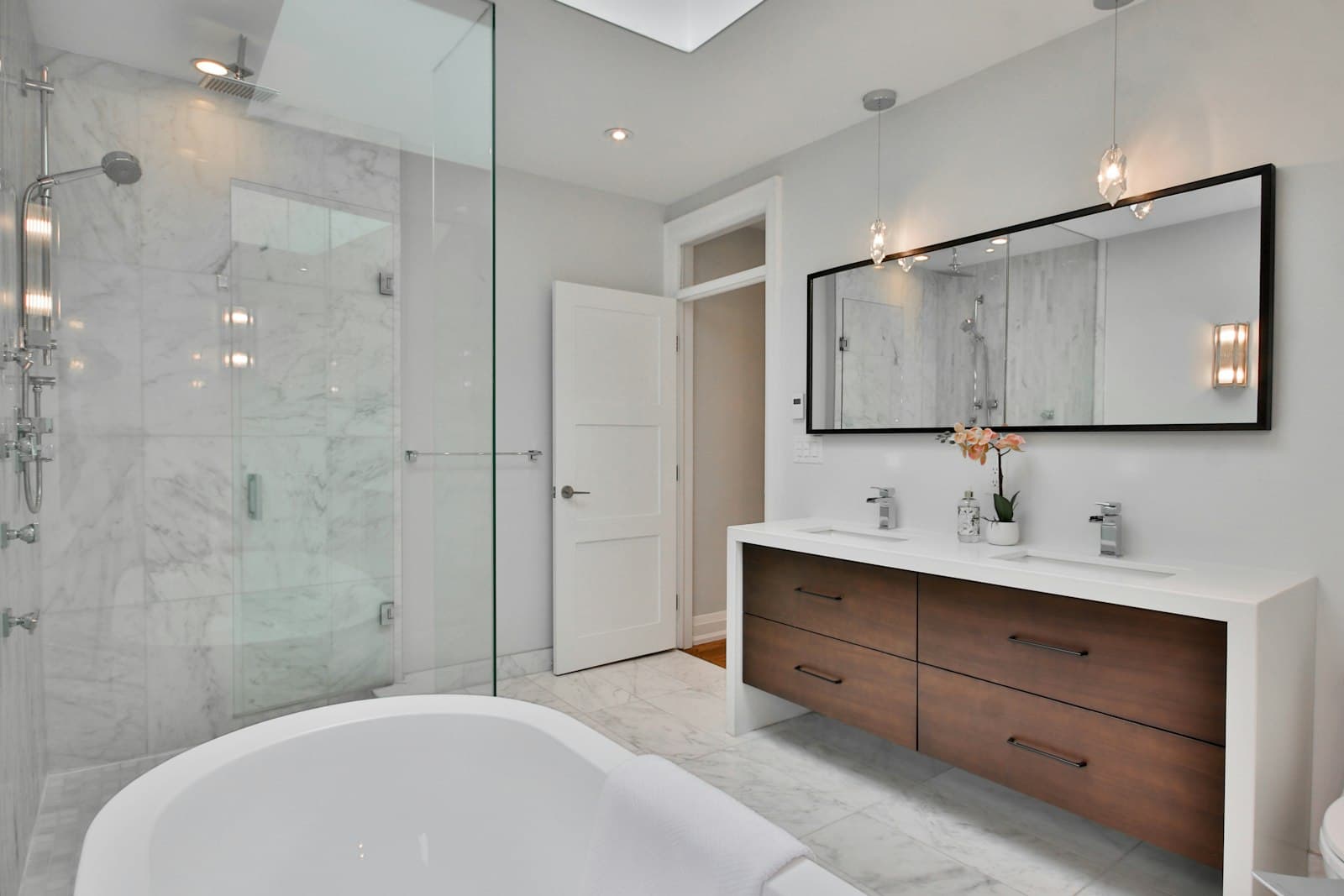
- Materials that dry. Porcelain tile, solid-surface or quartz tops and vanities built to stand up to humidity last longer than particleboard and painted drywall.
- An outdoor shower. Many Cape houses have one, and a good outdoor shower takes sand and salt out of the indoor bath. If you add or rebuild one, it needs its own drain plan and a winter shut-off, and the board of health may treat its drainage as part of the septic picture.
- Heat for the off-season. A heated floor or a small heater helps a bathroom dry out when the house is kept cool.
A remodeler who has worked on summer houses in Harwich, Chatham or Provincetown will have opinions on all of these. Ask what they have seen fail.
How large a deposit may a bathroom remodeler collect?
Not much more than a third of the price. The Massachusetts home improvement contract statute sets that ceiling, and lets it rise only to the actual cost of goods built or ordered to your measurements. A vanity made to fit an odd Cape bathroom wall or a glass enclosure cut to size can fall in that group; stock tile and a standard toilet do not.
Beyond the deposit, look for dates on the page: when demolition begins and when the room should be usable again. The agreement should also carry the remodeler's registration number, say who files each permit, and include the notice that you may cancel within three business days of signing.
What separates a $26,000 Cape bathroom from a $42,000 one?
The calculator default for a typical bathroom remodel on Cape Cod is about $25,900 to $42,300; see the Cape Cod bathroom remodel cost page for how it is built. A primary bath with a large tiled shower, radiant floor heat and custom cabinets lands above that. A powder room or a tub-to-shower conversion lands below.
The Cape adds a few cost factors:
- Septic work. If the board of health requires an upgrade, that is a separate, larger bill.
- Lead-safe work. Containment and cleanup on a pre-1978 house add labor.
- Distance. A crew based in Hyannis working in Chatham or Wellfleet is on the road part of the day.
What to ask before you hire
- Will you ask the board of health about my septic capacity before design?
- Do you hold a lead-safe renovation license, and who supervises it on site?
- Who are the plumber and electrician, and are they your employees or subcontractors?
- Which items are special-order, and what do they cost?
- What is the schedule, and when will the house be without a working bathroom?