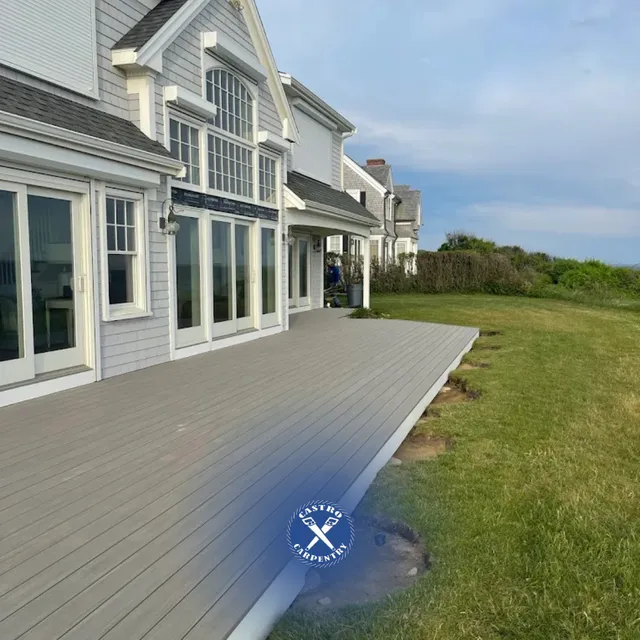
Decks, porches and outdoor showers are the carpentry projects Cape Cod owners call about most. They face the weather year-round, they get heavy summer use, and on a waterfront lot they sit in the path of storm water. Rebuilding one is real construction, with a permit, an inspection and, close to the shore, flood rules that affect how the frame is built.
Do you need a permit to rebuild a deck?
In almost every case. Replacing rotten deck boards on a sound frame may not need one, but rebuilding the frame, changing the size or height, or adding stairs generally does. Each Cape town runs its own building department, so a deck in Bourne, Mashpee or Brewster goes through that town's office and its inspector.
The permit usually involves a simple drawing showing size, height, footings, joist sizes and spacing, ledger attachment, stairs and guardrails. A carpenter who builds decks often will prepare it. Ask whether drawing and permit fees are in the price.
Expect an inspection of the footing holes before concrete, a framing inspection before boards go down, and a final. If the house is empty during the job, make sure someone can let the inspector in.
Footings mean digging, and digging means Dig Safe, with notice given at least 72 business hours in advance. On a Cape lot, also locate the septic tank and leach field before a new footing goes in.
Does a deck in a VE zone need special construction?
Yes, and this is where Cape carpentry gets specialized. Along the open shore, in parts of Chatham, Harwich, Falmouth and other towns, lots fall in VE zones, where flood maps expect waves. Each town's floodplain bylaw, kept by its building department, sets the local rules for building there.
The 10th edition of the Massachusetts building code adds rules for the Coastal A Zone, the area just landward of the VE zone up to the Limit of Moderate Wave Action. WHOI Sea Grant's explainer walks through how those zones are delineated and what the floodplain provisions require. For a deck in one of these zones, ask the designer and the inspector about three things:
- What footings or pilings the frame must stand on.
- How the deck attaches to the house, and whether it should stand on its own.
- Whether you may enclose any of the space underneath.
Ask your town's building department about your lot before design, and ask the carpenter whether they have built in VE or Coastal A zones before. A builder who has not may need an engineer on the job.
Work near a coastal bank or dune will also involve the town conservation commission, which can set conditions on how and when the job is done.
What should you ask about outdoor showers, porches and trim?
Beyond decks, three carpentry jobs come up constantly on the Cape.
Outdoor showers. Nearly every summer house has one, and most eventually rot at the base. A rebuild is a chance to fix the cause: a floor that drains freely, posts set off the ground or on proper footings, cedar or another rot-resistant wood, and stainless hardware. The plumbing belongs to a licensed plumber, and the drain may be something the board of health cares about; ask before you move it.
Porches. Screened porches and farmer's porches on older houses in Dennis, Harwich and Brewster often sit on posts and sills that have been wet for decades. A carpenter should probe the sills, the band and the post bases before quoting cosmetic work. Rebuilding a porch's structure is structural work under a permit.
Trim and sills. Corner boards, window sills, fascia and rakes take the weather on Cape houses. Many carpenters now replace rotted pine with PVC or composite trim that does not rot, painted to match. In the Old King's Highway district, ask whether the committee accepts the substitute on a visible face.
For each, ask the carpenter how they find the extent of rot before they price it, and for a unit price on anything they discover once boards come off.
Do you need a construction supervisor license for a structural repair?
The state wants structural jobs on one- and two-family houses run by someone with a Construction Supervisor License, and that person signs the building permit, under the state's rule for construction supervisors. Building or rebuilding a deck frame, replacing a sill, sistering joists, adding a beam or framing an addition all qualify. An owner doing their own work on a single-family home they live in can take a homeowner exemption; a contractor cannot.
Ask the carpenter whose license will be on the permit, and confirm that person is involved in the job, not just lending a name.
Is your carpenter registered?
A carpenter building on your home falls under the registration law, and the number should turn up when you search the Contractor Hub. Registration is what gives you access to the state's arbitration and Guaranty Fund if a registered contractor does not finish.
Once a carpentry job passes $1,000, the contract statute calls for a signed agreement. For a deck, that means the lumber and decking named, the footing plan, the price and its installments, a start and finish date, the permit, the carpenter's registration and a cancellation notice. Composite boards and custom rail systems are sometimes ordered for the job alone, which is the one case where a deposit may run past a third of the price; pressure-treated framing lumber never is.
How much does a 200-square-foot deck cost on the Cape, and what adds to it?
For a 200-square-foot pressure-treated deck, the market's calculator gives about $7,300 to $13,600; the Cape Cod carpentry cost page lets you change size and materials. Flood-zone footings, engineering, a second level, built-in benches or composite boards push it higher.
Two Cape factors: carpenters in Sandwich, Yarmouth and Orleans fill their spring calendars with owners who want outdoor space ready for summer, so a fall or winter build is easier to schedule. And salt air eats ordinary fasteners. Ask what the joist hangers, screws and post bases are made of.
Material lead times matter on the Cape too. Composite decking in a particular color, cable or glass railing systems and long cedar boards may need to be ordered weeks ahead from off-Cape suppliers. Ask the carpenter to confirm availability before the start date goes into the contract, and to tell you what they will substitute if a product is back-ordered. A deck that sits half-framed in Bourne or Wellfleet for a month waiting for railings is open to the weather and, on a rental, to guests who should not be on it.
Questions to ask a carpenter
- Will you draw the plans and pull the permit, and is that in the price?
- Whose Construction Supervisor License will be on the permit?
- Have you built in a VE or Coastal A zone, and do I need an engineer?
- What footings will you use, and how will you find my septic system?
- What fasteners and hardware will you use near salt water?