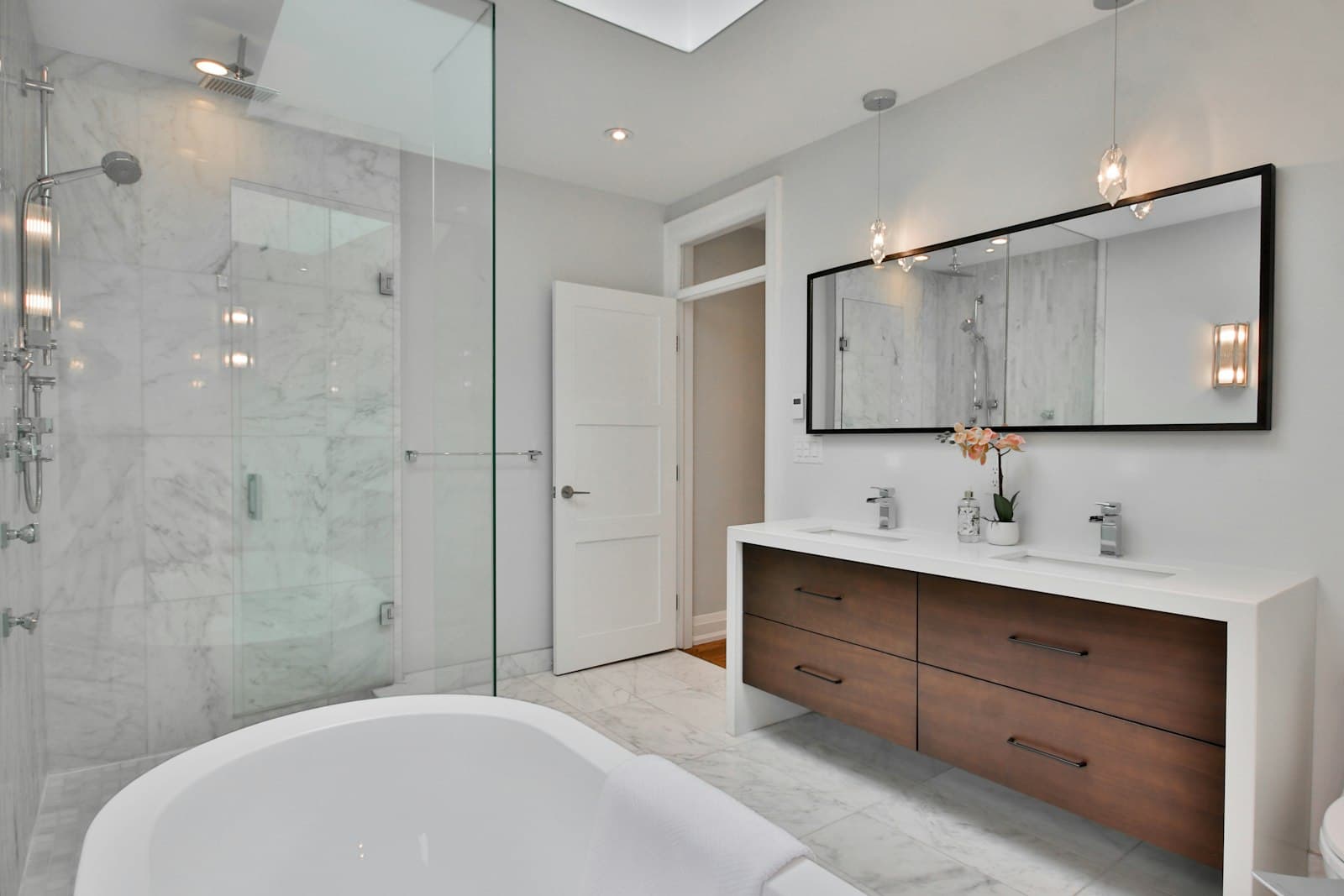
A bathroom is the smallest room most people remodel and the one with the most trades packed into it. In this market it is also frequently a room stacked on top of two others. Two- and three-family houses fill whole neighborhoods in Pawtucket, Central Falls, Woonsocket and Providence, and their bathrooms usually sit one above the next, sharing a drain and vent stack that runs from the roof to the basement. What you can do in your bathroom depends partly on what the pipe carrying your upstairs neighbor's water allows.
Remodeling one bath in a stacked triple-decker
If you own a unit or the whole building, a few questions come up before design:
- Moving the toilet. The toilet's position is tied to the stack. Moving it a few feet may mean opening the floor and the ceiling below. Ask the plumber where the stack runs before you fall in love with a layout.
- The ceiling below. Replacing a drain or a tub may mean opening the ceiling of the unit underneath. Who repairs that ceiling, and whether a tenant needs notice, belongs in the scope.
- Old cast iron. A remodel is a good time to look at the stack. Cracked cast iron behind a new wall is the kind of problem nobody wants to find after the tile is set.
- Water shutoffs. Many older buildings have one shutoff for every unit. Ask how long the building will be without water and plan around tenants.
For single-family houses in Cranston, Warwick or East Providence, the stack question is simpler, but the floor question is not. A cape built after the war may have a bathroom floor that has absorbed decades of small leaks. Budget for the possibility of subfloor repair.
Three license holders in one small room
A full bathroom remodel in Rhode Island has at least three credentials attached to it. The remodeler, and any non-employee tile setter or drywall crew, needs a registration from the Contractors' Registration and Licensing Board; you can search all of them on the CRLB contractor search. The plumber and the electrician are licensed separately by the Department of Labor and Training, on the DLT license search.
Before signing, get the plumbing and electrical subcontractors identified by name in the contract. If the answer is "my guys do everything," follow up: which of them holds the plumbing license, and whose name goes on the plumbing permit?
Who files the plumbing permit on a bath job?
Rhode Island's contractor law makes the contractor responsible for seeing that the permits required by the building code are secured before work starts (RIGL 5-65-3). On a bathroom, that usually means a building permit if walls are moving, plus plumbing and electrical permits pulled by the licensed trades. In Providence, the Department of Inspection & Standards takes all three online. In Middletown, Bristol or North Smithfield, the local building official issues them.
Inspections happen at rough-in, while the walls are still open, and at the end. Ask for the schedule. If the tile is going up before the rough plumbing has been inspected, something has been skipped.
Lead paint in pre-war bathrooms
Bathrooms in old houses carry painted trim, painted window sashes and sometimes painted plaster. The EPA's Renovation, Repair and Painting rule requires anyone paid to disturb painted surfaces in a home built before 1978 to be certified, with workers trained in lead-safe practices. The EPA estimates that about three-quarters of pre-1978 homes in the country still contain some lead-based paint.
What that looks like on the job: plastic sheeting sealing the bathroom off from the rest of the house, a ban on dry sanding and open-flame removal, and a careful cleanup and check at the end. Ask whether the firm is certified and who on the crew is the certified renovator. If children live in the house or in a unit below, this matters more.
Signing the contract, and when you cannot undo it
Any bathroom remodel crosses the $1,000 mark that triggers Rhode Island's written-contract requirement, with the mechanic's lien notice and the board's disclosures. Read it for:
- fixture and tile allowances, with a dollar figure for each;
- what happens if rot or a cracked stack is found once the walls are open;
- the inspection points and the payment due at each;
- who disposes of the old tub, which in a pre-war house may be cast iron and heavy.
Rhode Island gives no general right to back out once you have signed. Two exceptions exist. A sale personally solicited at your home can be cancelled within three days under the door-to-door law (RIGL 6-28-3), and an elderly homeowner solicited at home by a contractor has three business days under RIGL 5-65-27. Neither applies when you called the remodeler yourself. Read before you sign.
Fans, windows and the moisture that old walls hold
Many older bathrooms in this market were built with a window and no fan. Plaster walls and wood windows tolerated that for decades; a new, tighter bathroom with tile to the ceiling may not. A remodel should end with an exhaust fan that vents outdoors, not into the attic or a wall cavity, and a switch or timer that leaves it running long enough to clear the steam.
Ask the remodeler:
- Where will the fan duct exit the house, and how long is the run?
- Is the fan sized for the room, including a tall ceiling?
- What goes behind the tile in the shower: a cement board with a waterproofing membrane, or a sheet system?
- How will the old window, if it stays, be protected from shower spray?
In a triple-decker, the fan's exit can be the hardest part of the job, because the bathroom may be in the middle of the building. Solve it on paper before the walls are closed.
Coastal and seasonal bathrooms
Summer houses in Narragansett and Charlestown, and in-law units in older Newport houses, have their own bathroom issues. Outdoor showers, bathrooms that sit unheated all winter and fixtures that need draining before a freeze shape what you install. If the house is empty from October to May, ask about fixtures and supply lines that can be drained, and whether the remodeler can schedule the work in the off-season, when crews in South County are easier to book.
A Lincoln hall bath versus a Barrington primary bath
The Greater Providence calculator puts a typical bathroom remodel at about $25,600 to $41,900; adjust size and finish level on the bathroom remodel cost estimate for this market. A hall bath in a Lincoln ranch with fixtures in place sits low. A primary bath in a Barrington colonial with a moved toilet and a tiled shower sits high. In a stacked multifamily, add the work below the floor.