Tavlee
Coverage map
  • Explore
  • Saved
  • Log in
Tavlee
Coverage map
Tavlee

A trustworthy directory of home contractors — every claim sourced, licenses verified, rankings that can't be bought.

Trades in Greater Manchester

  • Plumbers in Greater Manchester
  • Electricians in Greater Manchester
  • HVAC Contractors in Greater Manchester
  • Roofers in Greater Manchester
  • General Contractors in Greater Manchester
  • Bathroom Remodelers in Greater Manchester
  • Kitchen Remodelers in Greater Manchester
  • Window, Siding & Gutter Contractors in Greater Manchester
  • Fence Contractors in Greater Manchester
  • Landscapers in Greater Manchester

Hiring guide · New Hampshire

Hiring an Exterminator in New Hampshire: Applicator Certificates, Tick Season and Mice in Closed Camps

By Tavlee · Published November 3, 2026

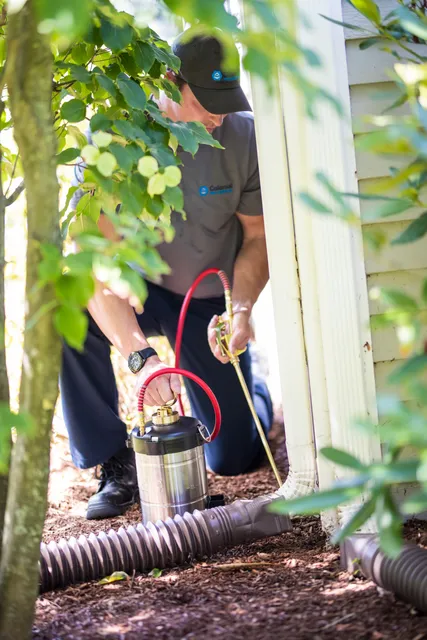
A technician in protective gear treating a yard
Photo: CDC on Unsplash

The short answer

A one-time general pest treatment runs about $120 to $300 in New Hampshire. Anyone applying pesticides commercially needs a state certificate of registration, and since the state publishes no searchable lookup, ask for the number and confirm it with the Division of Pesticide Control. Ticks run April to November, carpenter ants swarm in spring, and mice move into camps in fall.

Credential
State certificate for commercial application (RSA 430:33); no public lookup
Seasons
Ticks April–November; carpenter ants in spring; mice in fall
General treatment
About $120 to $300 (New Hampshire calculator default)
Typical cost
$120 – $300
Tracked on Tavlee
97 exterminators in Greater Manchester

Pest control in New Hampshire follows the seasons more than in most states. Ticks come out of the leaf litter in April and stay active into November. Carpenter ants swarm out of wet wood in spring. And when the nights turn cold in October, mice look for a warm wall, which in the Lakes Region often means a camp nobody will open until May. An exterminator who works in Wolfeboro or Ossipee spends the fall on mice; one in Derry spends the summer on ants and wasps. Both should hold the same state credential.

Confirming an applicator's state certificate

New Hampshire regulates the person who applies pesticides for pay. RSA 430:33 makes a state registration certificate the price of entry for anyone treating other people's property for pay. Applicants sit an exam, show they are financially responsible for damage, and renew every year. The Division can suspend or revoke it for careless application.

The catch is that you cannot type a name into a state website and see the result; the pesticide division puts out its lists as documents instead. So:

  1. Ask the company for the certificate number of the person who will treat your house, not just the company's.
  2. Call or write to the state pesticide office at the Department of Agriculture and ask whether that number is current.
  3. Ask which products will be used, and keep the label or a product list for your records.

A technician who will not give you a number, or who works under someone else's certificate without supervision, is a reason to call another company.

Ticks from April into November

Ticks are the pest New Hampshire homeowners ask about most, and they are active across the state from April through November. Spraying the edge of the yard is the most common service. Before you sign up:

  • Ask what product is used and how often it is applied in a season.
  • Ask how the technician keeps spray away from vegetable gardens, play areas, a private well and a neighbor's yard.
  • Ask whether the company also recommends habitat work, such as raking out the leaf layer and cutting back brush along the woodline, which cuts tick numbers without chemicals.

If your property is on a lake or river, pesticide rules tighten near the water. Within the 50-foot waterfront buffer, RSA 483-B:9 limits pesticide and herbicide application to licensed professionals or special permits. Ask whether the company sprays shoreland lots and how it handles that strip.

Carpenter ants and the wet wood they follow

Carpenter ants do not eat wood; they tunnel into wood that is already damp or rotting. A spring swarm of large black ants inside the house, or piles of sawdust-like frass under a window, usually means a colony in wet wood nearby: a leaking sill, a rotted deck ledger, a roof leak in a wall.

That makes carpenter ants half a pest problem and half a carpentry problem. A good exterminator in Jaffrey or Rindge will look for the moisture source and tell you to fix it, because treating the colony without fixing the leak invites the next one. Ask whether the inspection includes finding the nest and the wet wood, and whether they will tell you which repairs to make.

Mice in closed camps over the winter

In Tuftonboro, Freedom, Effingham and the other lake towns, mice move into closed camps in October and November and spend the winter in drawers, insulation and furniture. Owners find the damage in spring.

The lasting fix is exclusion: sealing gaps around pipes, vents, foundation sills and doors so mice cannot get in. Ask an exterminator:

  • Will you seal entry points, and with what material? Steel wool and caulk, metal flashing or hardware cloth last; foam alone does not.
  • What do you use inside: snap traps, bait stations, or both? Bait stations in a closed camp can leave dead mice in the walls.
  • Will someone check the camp during the winter, and what does each visit cost?

Get exclusion done in early fall, before the mice arrive, rather than after.

Wasps and yellow jackets by late summer

By August, yellow jacket nests in the ground and paper wasp nests under eaves and deck boards have grown to their largest, and they are most defensive in late summer and early fall. A nest by a door, a play area or a dock is a common urgent call.

Ask whether the company treats the nest the same day, whether they remove it afterward, and what they charge for a nest that is high up or inside a wall. A ground nest in a lawn is often treated at dusk, when the insects are inside. Do not seal a nest's entrance in a wall yourself: blocked insects can chew through to the inside of the house.

Bed bugs in rentals, dorms and ski condos

Bed bugs travel with people and luggage, so they turn up where people turn over: apartments near the colleges in Durham, Hanover, Keene and Plymouth, ski condos in Lincoln and Waterville Valley, and summer rentals on the Seacoast. They are a different job from an ant or mouse treatment.

If you own or manage a rental, ask a company how they confirm bed bugs before treating, whether they treat with heat, with products, or both, how many visits the treatment needs, and whether adjoining units must be inspected too. Ask what the tenant must do to prepare, and get the follow-up inspection in writing. Treating one room or one unit while the neighbor's goes untreated rarely holds.

Wells, children and pets: how products are used

Many New Hampshire homes draw water from a private well. NHDES recommends testing private wells every three to five years (NHDES private wells), and anyone treating around the foundation should know where the wellhead is. Tell the technician where the well is, and ask how far from it they will treat.

If you have young children or pets, ask how long they should stay off treated areas and whether there are lower-toxicity options for your pest. A professional should be able to explain the trade-offs without pressure.

Pricing a general treatment and comparing plans

A one-time general pest treatment runs about $120 to $300 in the New Hampshire pest control cost estimate. Quarterly plans, carpenter ant treatments, rodent exclusion and bed bugs are priced separately and cost more.

When you compare companies, look at what an inspection includes, whether follow-up visits are free if pests return, what a plan costs over a full year and how to cancel. Get the price, the pests covered, the products and the visit schedule in writing. Ask for the applicator's certificate number to be written on the service agreement.

In Lancaster or Jefferson, the nearest company may be a long drive away. Ask whether there is a travel charge and how quickly they can come for an urgent problem such as a wasp nest by a door.


What does pest control cost in New Hampshire?

Most treatments in New Hampshire run $120 – $300. Adjust the estimate for your job in the exterminator cost guide.

Top-rated exterminators in Greater Manchester

These are the strongest exterminators on the evidence: reviews and public mentions weighed across sources, every claim linked to where it was found. Rankings can't be bought.

BUG HUNT work photo

BUG HUNT

Same-day nest removal4.4

Mainely Grass work photo

Mainely Grass

Organic tick spray for a wooded lot4.4

Colonial Pest Control Inc. work photo

Colonial Pest Control Inc.

Proactive rodent sealing4.3

See all 97 exterminators in Greater Manchester

Hiring exterminators in New Hampshire: your questions

Do exterminators in New Hampshire need a license?
Yes. Applying pesticides commercially in New Hampshire requires a license from the state's agriculture or environmental authority. The state publishes no public lookup, so ask for the license number and confirm it with the New Hampshire Department of Agriculture — Division of Pesticide Control by phone or email before you sign.
How much does pest control cost in New Hampshire?
The calculator default, a one-time general treatment, is about $120 to $300. Quarterly plans cost more over a year but include repeat visits. Carpenter ants, wasps, rodents and bed bugs are priced on their own, and severe cases run higher.
Do I need a yearly pest contract?
Not always. A single treatment can handle a one-time problem. A seasonal or quarterly plan makes sense for recurring pests such as ants or mice in an older house or a camp. Ask what each visit includes and how to cancel.
Are termites a problem in New Hampshire?
Eastern subterranean termites occur in New England, but carpenter ants are a far more common call. Both damage wood. An inspector can tell them apart by the frass, the wings and the damage pattern before you agree to any treatment.
How do I prepare for a pest treatment?
Ask the company for a prep sheet. It usually covers clearing access to baseboards and the basement, putting away food and pet dishes, and how long children and pets should stay out of treated areas.

Sources

  • RSA 430:33: pesticide applicator registration
  • NH Department of Agriculture: pesticide licensing
  • RSA 483-B:9: shoreland buffer standards
  • NHDES: private wells

More guides

In other states: Greater Boston · North Shore · Greater Worcester · South Shore · Cape Cod · Western Massachusetts · Maine · Connecticut · Vermont · Greater Providence

Other trades in New Hampshire: Plumbers · Electricians · HVAC Contractors · Roofers · General Contractors · Bathroom Remodelers · Kitchen Remodelers · Window, Siding & Gutter Contractors · Fence Contractors · Landscapers · Painters · Waterproofing Contractors · Handymen · Carpenters · Flooring Contractors · Home Inspectors · Movers · House Cleaners · Pool Cleaners · Masonry Contractors

All New Hampshire hiring guides →

  • Painters in Greater Manchester
  • Waterproofing Contractors in Greater Manchester
  • Handymen in Greater Manchester
  • Carpenters in Greater Manchester
  • Flooring Contractors in Greater Manchester
  • Exterminators in Greater Manchester
  • Home Inspectors in Greater Manchester
  • Movers in Greater Manchester
  • House Cleaners in Greater Manchester
  • Pool Cleaners in Greater Manchester
  • Masonry Contractors in Greater Manchester
  • Exterminators nearby

    • Exterminators in Greater Boston
    • Exterminators in Merrimack Valley
    • Exterminators in North Shore
    • Exterminators in MetroWest
    • Exterminators in Greater Worcester
    • Exterminators in South Shore
    • Exterminators in Southeastern Massachusetts
    • Exterminators in South Coast
    • Exterminators in Cape Cod
    • Exterminators in Greater Nashua
    • Exterminators in Greater Providence
    • Exterminators in Greater Springfield
    • Exterminators in Greater Portland
    • Exterminators in Greater Manchester
    • Exterminators in The Berkshires
    • Exterminators in Seacoast
    • Exterminators in Lakes Region & Central NH
    • Exterminators in Monadnock & Upper Valley
    • Exterminators in North Country
    • Exterminators in South County
    • Exterminators in East Bay & Newport
    • Exterminators in Greater Hartford
    • Exterminators in Greater New Haven
    • Exterminators in Fairfield County
    • Exterminators in Eastern Connecticut
    • Exterminators in Litchfield Hills
    • Exterminators in Southern Maine
    • Exterminators in Lewiston-Auburn & Western Maine
    • Exterminators in Midcoast & Mid-Maine
    • Exterminators in Bangor & Downeast
    • Exterminators in Aroostook County
    • Exterminators in Champlain Valley
    • Exterminators in Central Vermont
    • Exterminators in Northeast Kingdom
    • Exterminators in Southern Vermont
    • Exterminator cost in Greater Manchester
    • Guide to hiring exterminators in New Hampshire
    © 2026 Tavlee Inc. All rights reserved.AboutPress & MediaGuidesBlogPrivacyTermsSupport Center

    Ratings weighed across every source · state-license verified · citations you can open.