Pest control is the one home service in Vermont where the state's licensing runs through the Agency of Agriculture rather than through a building or trade office. That makes sense when you think about it: the regulated thing is the chemical, not the house. It also means the checks are different from the ones you would run on a roofer or a plumber. Whether you are dealing with mice in a farmhouse in Glover, wasps under the eaves in Milton or ants in a camp near Island Pond, the questions start with who is applying what.
Who is allowed to apply pesticides in your house?
The Agency of Agriculture, Food and Markets certifies pesticide applicators and licenses the companies they work for. Its applicator certification page explains the system: commercial applicators are employees of pesticide companies who perform pest control services on other people's property, and a certified applicator must also be affiliated with a licensed pesticide applicator company.
For household pests, the category is 7A, general structural pest control. Related categories cover other kinds of work: 3A and 3B for ornamental trees and turf, 7B for some vector pests, 7F for disinfection, 8 for public health pest control. An exterminator treating your basement for mice or your walls for carpenter ants should be certified in 7A. A lawn company spraying for grubs would be in 3B.
So there are two things to check. Is the person certified in the right category, and is the company licensed? An individual with a certificate who is working on their own, with no licensed company behind them, does not meet the requirement the Agency describes.
Looking up a Vermont applicator before the first visit
The Agency's pesticide programs page offers ways to find certified applicators and licensed pesticide companies, including the state's own business and applicator look-up. Search the company name from the quote, and ask the technician for their name so you can search that too.
Do it before the first visit, not after. A company in Burlington or Rutland that has been in business for years will be there. If a company you found online does not appear, ask why. The answer may be innocent, such as a new trade name, or it may not be.
Treating a house that runs on a private well
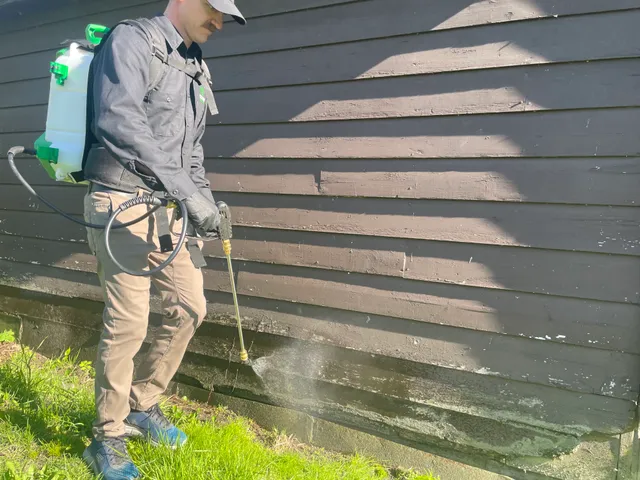
Many Vermont houses outside the town centers drink from a private well, and the well is usually close to the house. That changes how a careful exterminator works. Ask where they will apply product outside, how far that is from the wellhead, and whether the product they are using carries label restrictions near water. The label is the law for pesticide use, and the Agency's guidance is plain: always read and follow it.
The same goes for a house near a lake or a stream. A camp on Lake Memphremagog in Newport City, or a house on the river in Hardwick, sits close to water that the product should not reach. A company that works in those places regularly will raise the question before you do.
Mice, ants and the old Vermont house
Old houses give pests a lot of ways in: fieldstone foundations, gaps around sills, attached barns and sheds, firewood stacked against the walls. A good pest control company does more than spray. For rodents, ask about exclusion: sealing entry points with metal and mortar so the problem does not come back each fall. For carpenter ants, ask about the moisture problem that usually brought them, such as a wet sill or a leaking roof, because killing the ants without fixing the wet wood buys a season at most.
Ask what the company will do beyond treatment, what it will recommend that you do, and what is extra. A plan that is all chemical and no inspection is the weakest kind. In a house in Barre or Manchester with an attached woodshed or barn, ask whether the inspection and the treatment reach those spaces too, since that is often where the problem starts and where the company may not look unless you ask. Ask also how the company handles dead rodents inside walls, which is a question nobody wants to face in February.
Yard spraying for ticks and mosquitoes
Some Vermont pest companies, and some landscapers, sell yard treatments for ticks and mosquitoes. That is pesticide application for hire like any other, and the certification categories reach it: the Agency lists vector pest control among its commercial categories, alongside turf and ornamental work. Ask which category the applicator holds and which product will be used.
Ask too what the treatment will touch besides the target. A barrier spray along the edge of a lawn reaches whatever else lives there, including pollinators on flowering plants, and runoff from a treated slope can move toward a well, a pond or a stream. A company that asks about your garden, your well and any water nearby before quoting is taking the question seriously. Many households combine a narrower treatment with simple measures, such as keeping grass short at the woods' edge and moving leaf litter away from paths, and a good company will suggest those instead of selling the largest plan.
Service plans, guarantees and how to compare them
Many exterminators in Vermont sell plans: quarterly or seasonal visits, a guarantee that they will return between visits if the pest does, and sometimes a discount on the first treatment. Plans suit some problems, such as a house with recurring mice, and not others, such as a single wasp nest.
The Vermont calculator default for a typical treatment is about $130 to $330; the Vermont exterminator cost page compares common pests. Before you sign a plan, ask how long it runs, how it renews, how you cancel, what pests it covers, and what the guarantee actually promises. Get it in writing. A plan that renews automatically every year with no reminder is worth reading closely.
Bed bugs and rentals in the college towns
Bed bugs travel with people and furniture. In the college towns, Burlington and Winooski around UVM and Middlebury around the college, late-summer rental turnover moves a lot of both between apartments. Treatment usually takes more than one visit, and preparation by the tenant or owner matters as much as the treatment itself. Ask the company for a written preparation list and a follow-up schedule.
Landlords should keep records of every treatment, including the product and the date. If you are a tenant, ask the landlord who is treating the unit and whether that company is licensed; you have a right to know what is being applied where you live.
What to keep after the treatment
Keep the invoice, which should list the products used, the amounts and the areas treated, along with the applicator's name. If something goes wrong, from a pet that gets sick to a pest that does not go away, that record is what the company, your doctor or veterinarian, or the Agency will want to see. The Agency takes pesticide complaints through an online form and by phone. In South Burlington, Bennington or Brattleboro, as anywhere in the state, a company that hands you that paperwork without being asked is a good sign.