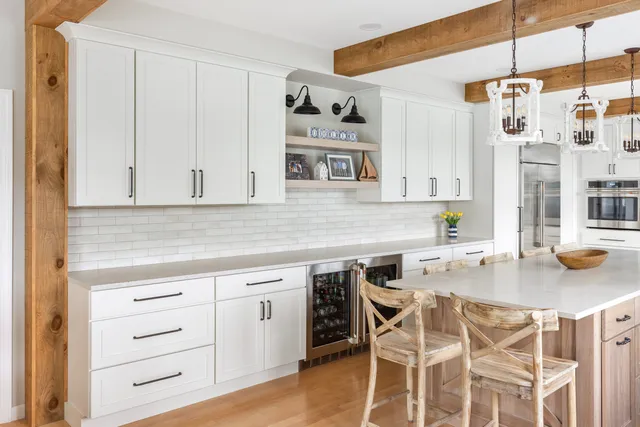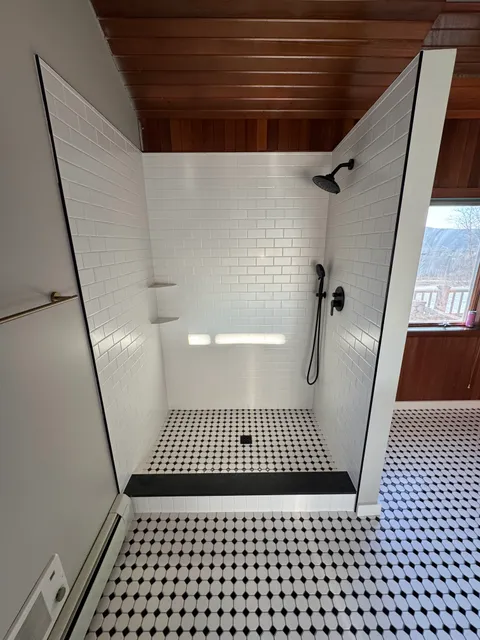
A kitchen is where a Vermont homeowner is most likely to sign a contract big enough for the state's contractor law to apply in full. Few complete kitchen remodels come in under $10,000, so the written-contract and deposit rules in chapter 106 are not background reading here; they set the terms of the deal. This guide works through those rules with numbers, then turns to the parts of a kitchen job that are licensed separately.
Working out the legal deposit on a kitchen contract
The deposit rule sits in section 5509 of 26 V.S.A. chapter 106. When a contract sets a maximum price, or a time-and-materials price with a ceiling, the down payment may be as much as one-half of the labor cost or one-half of the materials price, whichever of the two is larger. The rule does not apply to an uncapped time-and-materials contract, where the deposit is whatever the parties agree.
An illustration makes this concrete. Suppose a kitchen in Shaftsbury is priced at $28,000, with $12,000 of that being labor and $16,000 being cabinets, counters and other materials. Half the labor is $6,000; half the materials is $8,000. The larger figure, $8,000, is the most the remodeler may take as a down payment. A request for $14,000 up front on that contract is over the line.
The legal ceiling is not the advice. The Attorney General's home repair checklist says a deposit ideally stays at 10 to 30 percent. Cabinets are often ordered weeks in advance and a remodeler may reasonably want them covered; ask for the cabinet order confirmation before paying for it.
What has to be on paper before demolition
Section 5509 lists four things a written contract over $10,000 must contain. It must say which of the three price bases applies. It must give estimated start and completion dates. It must describe the scope and the materials. And it must set out how changes will be made, with each change recorded in a signed writing.
For a kitchen, "materials" should mean names and numbers: the cabinet line and finish, the counter material and edge, the sink and faucet, the flooring, and the appliances if the remodeler is supplying them. Anything still undecided becomes an allowance with a dollar figure. "Scope" should include demolition, disposal, any wall or window changes, patching, painting and cleanup.
The registration that comes with the contract is quick to check. Search the remodeler on the OPR lookup, and ask for the certificate showing the liability coverage the statute requires.
A full kitchen remodel commonly takes the room out of service for weeks, and in a Vermont winter that is not a small thing. Plan a temporary kitchen elsewhere in the house: a refrigerator, a microwave or hot plate, and a utility sink if there is one. Ask the remodeler to set the order of work so that the sink and the range return as early as possible, and to write the completion estimate into the contract as the law requires. If you are timing the job, spring and summer starts avoid the worst of it.
Gas ranges, propane and who connects them
Propane is one of the delivered fuels the Department of Public Service tracks, and plenty of Vermont ranges run on a tank outside. Connecting a range, moving a gas line or adding a gas cooktop is gas work, and the Division of Fire Safety certifies gas technicians separately from plumbers and electricians. Ask who will make the gas connection and which certification they hold. A remodeler in Brandon or Barton who says "the cabinet guy will hook it up" has not answered the question.
The appliance itself is different. Vermont's registration law exempts installers who only put in appliances, audio-visual equipment or networks. So the delivery crew that sets an electric range does not need to be on the register, but the kitchen remodeler running the whole job does.
The sink is licensed work too. Under 26 V.S.A. § 2198, plumbing for hire must be done by a Division of Fire Safety licensed plumber; moving the sink to an island means a licensed plumber on the job.
Old kitchens in Burlington's catalog houses
Burlington has a particular kind of older house in its neighborhoods: the mail-order catalog home, shipped as a kit and built from a plan book. The city's permit office thought these worth a dedicated Guide to Catalog Homes in Burlington. Kitchens in houses of that era were small and closed, and the remodel most owners want is to open them up.
Opening a wall in any old house raises two questions before a price is firm. Is the wall carrying load, and what does it take to replace it with a beam? And does the wall contain plumbing vents, ducts or wiring that must be rerouted? Ask the remodeler to open a small inspection hole or bring in an engineer before committing to a fixed price on a wall removal.
Lead dust in a pre-1978 kitchen
Kitchens in older Vermont houses have usually been painted many times, and the Health Department presumes lead paint is present in any home built before 1978. Its RRPM rules require licensed lead-safe work as soon as a job disturbs over a square foot of paint in any one room. Removing old cabinets, trim or a painted wall in a Montpelier or Winooski kitchen passes that quickly.
A kitchen is also where food is prepared, so containment matters. Ask the remodeler who holds the RRPM license, how the space will be sealed off from the rest of the house, and how the final cleaning will be checked.
Permits from Burlington to the smaller towns
Burlington requires zoning approval first, and then a building permit for non-plumbing work beyond painting, carpeting and small in-kind repairs; the details are on the city's construction permits page. Plumbing, mechanical and electrical work need a separate trades permit. In Vergennes, Bristol, Pittsford or Poultney, call the town zoning administrator; most Vermont towns issue zoning permits and do not inspect interior work. If the kitchen remodel is part of an addition, the state's energy code certificate may apply as well.
A kitchen in a duplex or a rental unit
The permit picture changes when the kitchen is not in an owner-occupied single-family house. The Division of Fire Safety's permit summary lists duplexes and rental buildings among those that need state construction permits, so a landlord remodeling a unit in Bennington or Montpelier may face state review that the owner of a single-family house would not. Ask the remodeler whether they have pulled state construction permits before and who will handle that application.
Matching the remodeler to your corner of Vermont
The Vermont calculator default for a typical kitchen remodel is about $20,200 to $30,800; the Vermont kitchen cost page shows how cabinet grade and layout change the figure. Where you live shapes who bids. In Chittenden County you may have a dozen remodelers to choose from. On the islands in South Hero, in Cabot, or in a Kingdom town, you may have two, and the best of them may be booked months out. Ask early, ask for kitchens they have done nearby, and call those owners. A remodeler whose past clients answer the phone happily is a good sign in a state where everyone knows everyone.