Vermont plumbing splits along a line most homeowners never think about until they need a permit: whether the house drinks from a town main or from its own well. In Burlington, Winooski or downtown Montpelier you are almost certainly on public water and sewer. A mile outside Middlebury, Hardwick or St. Johnsbury you may well be pumping from a drilled well into a septic tank. The license rule is the same everywhere, but the permit and inspection picture is not.
Who is allowed to plumb a Vermont house for pay?
Vermont's plumbing statute is short and strict. Under 26 V.S.A. § 2198, plumbing in the state has to be done by a plumber holding a license from the Division of Fire Safety's Plumber's Examining Board. The one carve-out is for an owner doing the work in the owner-occupied single-family home they live in. The moment money changes hands, the person under your sink needs the license.
The Division of Fire Safety issues several grades: master (PM), journeyman (PJ) and specialist (PS), plus narrow specialties such as the P1 water heater and P2 heating system endorsements. A water heater swap can legally be done by someone who holds only the P1 specialty; a full bathroom rough-in calls for a master or a journeyman working under one. Ask which grade the plumber holds and check it on the state's licensed plumbers list, which you can search by name or town.
Larger jobs carry a second layer. If the plumbing is part of a contract worth more than $10,000 in labor and materials, chapter 106 also applies. The registration law lists plumbing among the kinds of residential construction it covers, though a licensed tradesperson working within that license is exempt from registering with the Office of Professional Regulation. The written-contract and deposit protections in that chapter are worth asking for on a big job either way.
Does a plumbing permit apply if you are on a town main?
This is where Vermont differs from its neighbors. The Division of Fire Safety's permit summary shows that a state plumbing permit applies to an owner-occupied single-family home only when the house is connected to public water or sewer. State plumbing rules reach the premises tied into a public system in any town that has one. A farmhouse in Craftsbury on its own well and septic is outside that state permit, although local rules may still apply.
Burlington adds its own layer. The city's Building Trades Division requires a trades permit for plumbing, mechanical and electrical work, and Vermont adopted updated 2025 plumbing rules in November 2025. A Burlington plumber should pull that permit; if one tells you the job "doesn't need anything," ask why.
Duplexes and rentals are a separate category. The same state sheet lists duplexes and rental buildings, alongside public buildings, as needing state construction permits, so a landlord in Rutland City or Brattleboro should expect paperwork the owner of a single-family house might not see.
What changes when the water comes from a well and goes to a septic tank?
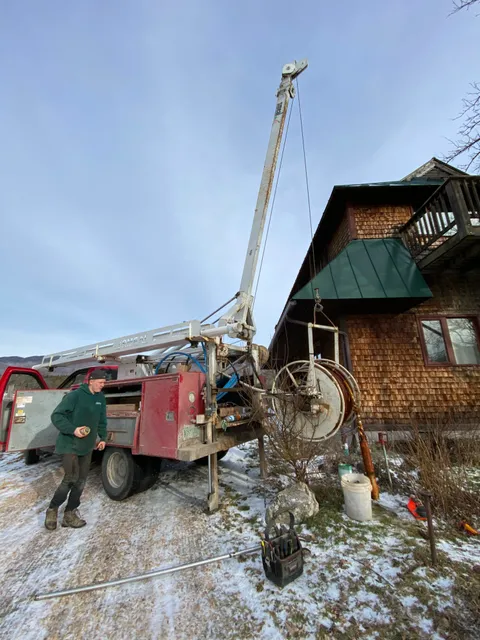
Off the mains, two other agencies take over. The Department of Environmental Conservation's Wastewater System and Potable Water Supply Program permits soil-based septic systems under 6,500 gallons a day, private water supplies, and new connections to municipal water or sewer. A licensed designer has to prepare the plans, and the permits come from five regional offices in Montpelier, Essex, Rutland, Springfield and St. Johnsbury.
That matters for scope. A plumber can replace a pressure tank, a well pump control or the pipe from the house to the tank, but moving a leach field or adding a bedroom that changes the design flow is a DEC permit question first. Get that answered before you sign for a basement apartment.
The same program offers financial help to homeowners who are forced to replace a failed water or wastewater system, which is worth asking about before you price a replacement on your own.
Why the 2023 flood belongs in your well conversation
The July 2023 storm hit hardest in places with more wells than water mains. The National Weather Service's summary of the flood singles out small towns on the eastern slopes of the Green Mountains, among them Londonderry, Weston, Ludlow and Hardwick, as badly damaged. In those towns a flooded basement often meant a flooded well head, a drowned pump and a septic field under water.
If a plumber is restoring a well system after high water, the Health Department's new well testing page lists what a new drilled well must be tested for: E. coli and total coliform, arsenic, fluoride, lead, manganese, nitrate and nitrite, uranium, gross alpha, chloride, sodium, iron and pH. Treatment is not required by law for a single-family well, so the decision is yours. A good plumber will tell you which results call for a filter and which do not, and will not sell you a treatment system before the lab report is back.
How long will you wait, and what should the quote cover?
The Vermont calculator's default for a typical plumbing job is about $240 to $590; the Vermont plumbing cost page breaks that down by job type. Distance is the hidden line item. A plumber based in South Burlington or Essex Junction may serve the whole of Chittenden County in a day; one based in Barre may cover two counties, and a call to a camp on the far side of the Northeast Kingdom can mean an hour on the road each way. Ask whether travel time is billed and whether there is a minimum charge.
For anything beyond a repair, ask for the scope in writing: fixtures and their model numbers, who supplies them, whether walls will be opened and who closes them, and the permit if one applies. The Attorney General's home repair checklist suggests keeping a deposit to roughly 10 to 30 percent; on a capped contract over $10,000 the statute's own ceiling is half the labor or half the materials, whichever is greater.
Is a heat pump water heater worth asking the plumber about?
If your tank is near the end of its life, the swap is a natural moment to change type. Efficiency Vermont's 2026 rebate list offers $600 toward a heat pump water heater, with another $400 for income-eligible households. These units pull heat from the air around them, so they want a basement or utility room with some space, and they need a condensate drain. Ask the plumber whether your basement in Shelburne or Bennington suits one, who files the rebate, and whether the price quoted is before or after it.
Signs a plumbing bid deserves a second look
A few patterns are worth slowing down for. A plumber who cannot give you a license number, or whose name does not appear on the state list, is working outside the law unless you are the owner doing your own house. A price for a "new septic" with no mention of a licensed designer or a DEC permit is incomplete. A quote that bundles an expensive treatment system before the well has been tested is selling, not diagnosing.
Winter adds urgency but not an excuse. A frozen supply line in January in Middlebury needs a fast answer, and emergency work is treated differently under the registration law, but you are still entitled to know who is doing the work and what the hourly rate is before the torch comes out.