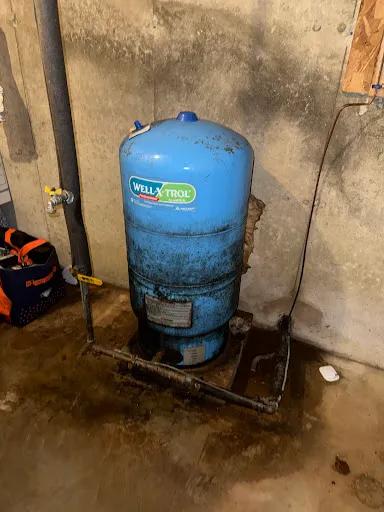
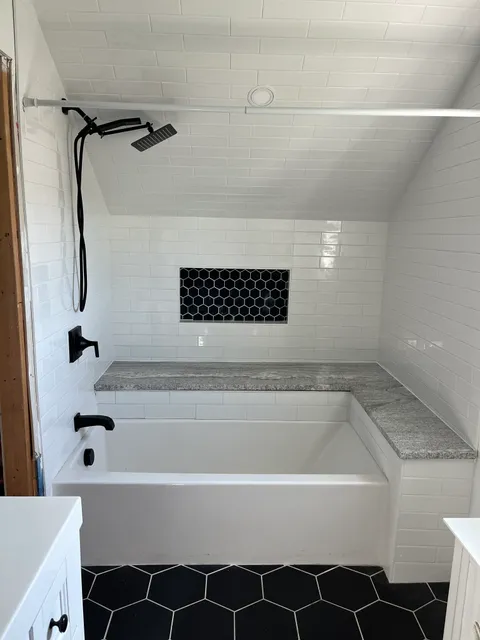
Plumbing in Maine splits into two worlds. In Portland, South Portland and the denser parts of Lewiston and Bangor, a plumber is working on city water and city sewer, usually in an older house with a cramped basement. Out past the sewer lines, which in Maine means most of the map, the same plumber is also dealing with a well pump, a pressure tank, a water treatment setup and a septic system. Knowing which world your house sits in tells you what kind of plumber to call and what paperwork the job will create.
Whose name should you search on the state's license lookup?
Maine licenses plumbers as individuals. There are master and journeyman plumber licenses, and they belong to the person, not the business. Maine does not issue a plumbing company license at all, so a truck with a company logo tells you nothing about who is qualified.
The practical move is to ask, before anyone starts: which master plumber is responsible for this job? Then type that person's name into the state's ALMS license search, run by the Office of Professional and Occupational Regulation. You should see an active license under that name. If the person who shows up is a journeyman, ask who the supervising master is and look that name up too.
This matters more in Maine than in a lot of states because almost nothing else about home building is licensed here. Your plumber and your electrician are two of the few trades on a renovation who have to hold a state credential, so it is worth the two minutes.
Are you on a well, and what should the plumber know about it?
The Maine CDC puts it plainly: about half of the state's homeowners get their drinking water from private wells, and in its own phrasing that makes them "practicing hydrogeologists" (Maine CDC on wells). Private wells are not regulated by the state. Nobody tests yours unless you do.
That has two consequences when you hire a plumber.
First, a plumber who replaces a pressure tank, a well pump or a water heater is often the first person to see your water in years. If they suggest a test, the advice lines up with the state's. Maine CDC recommends testing every year for coliform bacteria, E. coli and nitrate or nitrite, and every three to five years for a longer list that includes arsenic, uranium, radon, manganese, hardness and iron (Maine CDC well water testing). The CDC runs a free help line, 866-292-3474, and households with low incomes can ask for test kits.
Second, the test result decides the equipment. A softener, an arsenic filter or a uranium system are different purchases. Get the lab result before you agree to a treatment package, and ask the plumber to tie each piece of equipment to a number on that result.
What happens when a camp in Raymond or Naples needs septic work?
Most homes outside the city cores run on a subsurface system, and Maine governs those under the Subsurface Wastewater Disposal Rules, 10-144 CMR Chapter 241, in their 2023 edition (the rules).
A new or replacement system has a sequence. A licensed site evaluator designs it; site evaluators are licensed by Maine DHHS. The town's Licensed Plumbing Inspector (LPI) issues the permit. The system gets two inspections, and the permit covers work begun within 24 months (Maine CDC permitting). The installer who digs it is a separate question: the Attorney General's home repair page notes that septic installers don't have to be licensed, though a voluntary certification exists.
So a septic job around Sebago Lake or the Belgrade Lakes involves at least three parties: the evaluator, the installer and the LPI. Ask your plumber or installer who is hiring the site evaluator and whether the design cost is in the quote.
A second camp rule surprises people. If the camp sits in the shoreland zone and you want to turn it into a year-round or principal home, Maine law requires a conversion permit from the local plumbing inspector first (30-A M.R.S. §4215). The inspector is looking at whether the septic system can carry year-round use. Plan that before you pay for a winter-ready water line.
How should a seasonal place be closed for the winter?
Closing a camp in Bridgton, Rangeley or on the Downeast coast is one of the most common plumbing calls in fall. A good closing covers draining the supply lines and the water heater, blowing out lines that can't drain by gravity, adding antifreeze to traps, and shutting down and draining the well pump and pressure tank. Ask the plumber to leave a written list of what was drained and what was treated, and to tag the main valves. The spring opening goes faster when the person doing it can read what was done in October.
If you rent the place out, ask whether the plumber offers a set closing and opening date each year. Plumbers in the Bangor area, around Farmington or up in Presque Isle may cover a wide territory with a small crew, and the dates fill up.
What makes an older Maine house hard on pipes?
Cold is the main enemy. Pipes in an exterior wall, a crawl space over ledge, or a kitchen added onto a farmhouse are the ones that freeze. When a plumber quotes a repair after a freeze, ask whether the line can be rerouted inside the heated envelope rather than patched in place, and whether the fix needs insulation or air sealing that someone else should do first.
Old supply lines are the second issue. Galvanized steel in a 1920s Portland house or a Lewiston tenement corrodes from the inside and slows to a trickle; a patch on one section often moves the clog to the next. Ask the plumber to tell you what material each run is made of and to price a section-by-section replacement and a full repipe side by side, so you can see the difference.
What does a Maine plumbing call cost?
The Maine calculator default for a typical repair call is about $240 to $590, and the Maine plumber cost estimate shows how the range is built. Travel is the first thing that moves it. A plumber based in Lewiston driving to a lake house an hour away will charge for that time, and a Machias or Belfast homeowner may have only a few plumbers within reach.
The second thing is season. A frozen pipe in January, when every plumber in town is getting the same call, costs more and waits longer than the same repair in May.
When does a plumbing job need a written contract?
Maine's Home Construction Contracts Act counts plumbing and heating work as home construction (10 M.R.S. §1486). Once a plumbing job is priced above $3,000 in materials or labor, such as a full repipe, a new septic system or a water treatment package, the statute requires a written contract that both of you sign, with each side holding a copy before work begins (10 M.R.S. §1487). The first payment can't be more than a third of the price.
The written contract also has to give estimated start and finish dates, describe the materials, and include the warranty language set out in the law. For a well-pump swap that turns into a whole new water system, that means a revised paper before the plumber orders the bigger equipment.
If something goes wrong on a permitted job, the AG's page points homeowners first to the town's plumbing inspector and then to the Plumbers' Examining Board.