Most of Massachusetts buys its electricity from one of two big investor-owned utilities. A slice of the Pioneer Valley does not, and that single fact changes how an electrical job is planned, paid for and connected. Before you hire an electrician in the Springfield area, find out who sends your electric bill.
Is your power from Eversource or from a city light plant? It changes the rebate
Four communities in the valley run their own municipal light plants. Holyoke has Holyoke Gas & Electric, Westfield has Westfield Gas + Electric (which sells both fuels), Chicopee has Chicopee Electric Light, and South Hadley has SHELD. Around Springfield and Pittsfield the electric utility is generally Eversource, the former Western Massachusetts Electric.
For an electrician, the difference shows up in three places:
- Rebates. Mass Save's statewide program asks for your zip code and heating fuel before it tells you what you qualify for, on its heating and water heating page. A light-plant customer should start with the city utility instead. HG&E, for instance, lists its own 0% REAP financing for heat pumps, weatherization and solar, and a $1,000 rebate on a home battery.
- Service work. A meter pull, a new service drop or a disconnect for a panel swap is scheduled with whoever owns the wires to your house.
- Interconnection. Solar and battery hookups go through the local utility's process.
Ask any electrician you interview whether they work regularly in your utility's territory. A Springfield shop that has never dealt with Chicopee Electric Light can still do the job, but may lose a week learning the paperwork.
The license and the wiring permit
Every person doing electrical work in a Massachusetts home has to hold a state license, master or journeyman, from the Board of State Examiners of Electricians. Since October 2026 that board's licensees are searched on eLIPSE, the state occupational licensing portal, so older printed license cards may show a different lookup address. Type the name or number there and read the status.
The permit is separate. Your town's wiring inspector issues it, and in the 18 Franklin County towns in FRCOG's cooperative program the electrical inspector is regional, not municipal. Pittsfield takes electrical permits online only. In every case, the licensed electrician applies. A handyman who offers to "just swap the panel" without a permit is offering work the state does not let them do.
Will a heat pump need a bigger panel in a 1950s Ludlow ranch?
It might. The postwar ring around Springfield is large: about 15.8% of Hampden County's homes went up in the 1950s and another 13.4% in the 1960s, according to the Census Bureau's American Community Survey. Many of those ranches and capes in Ludlow, Agawam, Wilbraham and East Longmeadow still run on a 100-amp service sized for a fridge, a range and lights, with oil heat that needs almost no electricity.
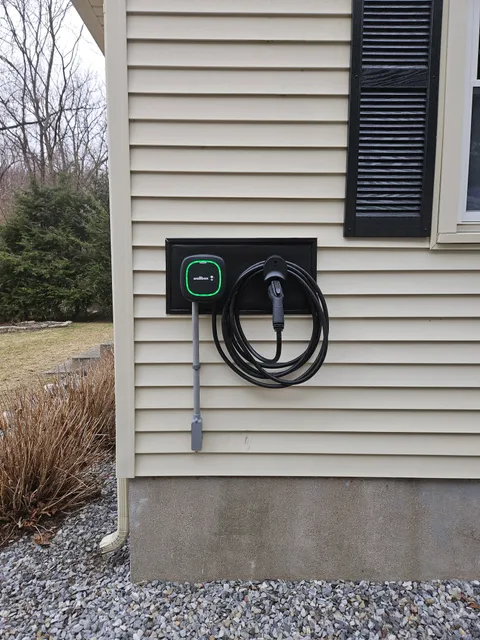
A whole-house heat pump changes that. So do an induction range, a heat-pump water heater and an electric car charger, which homeowners often add in the same year. Before the HVAC installer orders equipment, have an electrician do a load calculation and tell you in writing whether the panel and service can carry the new load. The answer is one of three:
- The existing service handles it with a new circuit or two.
- A load-management device can share capacity between big loads.
- A service upgrade, often to 200 amps, is needed, which brings in the utility.
Get that answer before you sign the heat-pump contract, not after. A service upgrade can add weeks and a separate permit to a job that was quoted as a one-week install.
Old wiring in pre-1940 valley and Berkshire houses
The western counties hold some of the oldest housing in the state. More than a third of Berkshire County homes were built in 1939 or earlier, and about 31% in Franklin County, per the same Census tables. In a North Adams mill-worker house, a Holyoke canal-side block or a Williamstown farmhouse, the wiring may be a patchwork of generations, with ungrounded circuits, undersized feeds to additions and splices hidden in walls.
When an electrician quotes work in a house that old, ask:
- Will you open junction boxes and trace circuits before you price this, or after?
- What happens to the price if you find an older wiring type behind the wall?
- Will grounding or arc-fault protection be required by the inspector once you touch the circuit?
A fair electrician will describe the unknowns rather than promise a fixed price on a wall nobody has opened.
Generators, transfer switches and the long outages
Western Massachusetts loses power in big storms, and stays out longer in the hills. The December 2008 ice storm left up to a million customers statewide in the dark, and the October 2011 snowstorm brought down trees still in leaf across the Berkshires and the valley. In a hilltown house the outage stops more than the lights: the well pump, the boiler's burner and circulator, and the sump all need power.
Your options, from cheapest up:
- An inlet and a transfer switch for a portable generator. The electrician wires selected circuits to a switch, and you plug the generator into an inlet outside.
- A standby generator on propane or natural gas that starts by itself. This matters most in a second home in Great Barrington or Hancock that sits empty for weeks.
- A battery, sometimes paired with solar, which in Holyoke carries the HG&E rebate mentioned above.
Any of these is licensed electrical work with a permit, and a standby unit on propane adds gas piping by a licensed gas fitter. The NWS Albany office forecasts for Berkshire County and is the place to watch when an ice storm is coming.
Booking rental electrical work in Amherst and Northampton between May and August
The college towns run on a calendar. UMass, Amherst College, Smith, Mount Holyoke and Hampshire College empty their rentals in May and fill them again in late August, and Williams does the same in Williamstown. For a landlord with a two-family on a street of student rentals, that leaves a summer window to do the electrical work that is hard to schedule with tenants in place: replacing a tired panel, adding kitchen circuits so space heaters and air fryers stop tripping breakers, or putting smoke and carbon monoxide alarms on a common circuit.
Electricians in Amherst, Hadley and Northampton know this, and their summer books fill early. If you own a rental, call in March, ask for a written scope that names each unit, and agree on what happens if the inspection is not closed out before move-in day. A job that leaves a unit without power the week tenants arrive costs more than the electrician's invoice.
What an electrician's visit costs from Springfield to the hills
The Western Massachusetts calculator puts a typical electrical job at about $480 to $1,000, and the electrical cost estimate for this market adjusts it for your scope. Inside that range, the drivers are scope, access and distance. A Hadley or Amherst electrician coming to a nearby subdivision is cheap to schedule. The same electrician driving up to Hawley or Florida for a single outlet will either bundle it with other work or add a trip charge. Ask whether the quote includes the permit fee, the inspection visit and the drywall patch, and whether a load calculation is billed separately.