Electricians in Greater Providence spend a lot of their time inside very old houses. Census figures put 54.5% of Providence's housing units in the built-in-1939-or-earlier column, against roughly 30% for Rhode Island as a whole (ACS year-built table). The two-families of the West End, the mill houses of Woonsocket and the older streets of East Providence and North Providence were wired for lamps and a radio. They now carry kitchens full of appliances, window air conditioners and, more and more, heat pumps.
What an electrician may find behind the plaster of a pre-1940 house
Older wiring is not automatically dangerous, but it is often undocumented. In a house that has been through several owners, it is common to find original wiring still live in one part of the house, newer cable in another, and splices in places nobody remembers. When you bring an electrician in, ask for a walk-through before any price:
- Which circuits are original, and are any still carrying load?
- Is there grounding at the outlets, or only two-prong receptacles?
- Has anyone buried a junction box in a wall or ceiling?
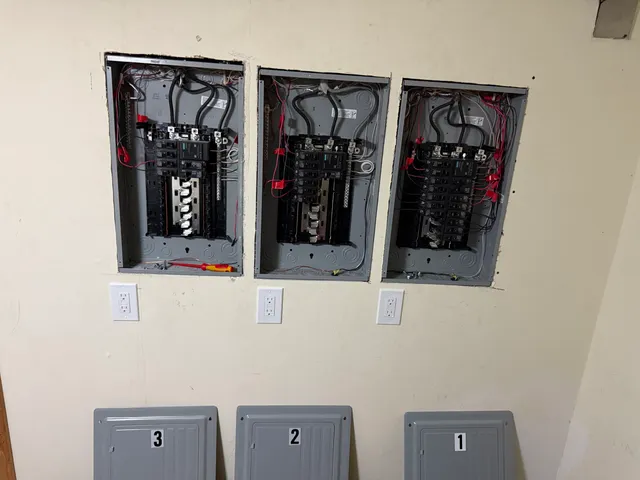
- What does the panel look like, and does it have room for more circuits?
A careful electrician will tell you what must be fixed for safety, what a building inspector will want if walls are opened, and what can wait. Get that split in writing. It keeps a small job from quietly turning into a whole-house rewire, and it gives you a plan for later work.
Insurance can also drive the timeline. Some insurers ask about wiring type when a house in Providence or Pawtucket changes hands, and a buyer may need an electrician's letter quickly. Book the inspection before the purchase deadline, not after.
Panel and service changes go through the building official
A panel replacement or a service upgrade is permitted work everywhere in the state. Rhode Island uses a single statewide building code, applied by each city or town's building official. In Providence the Department of Inspection & Standards takes electrical permit applications online; in Cranston, Warwick or Bristol you go through the town's building office. The utility is part of any service upgrade too, since the meter and the service drop have to be disconnected and reconnected.
Plan for the utility's schedule. A service change is often a two-visit job: the electrician prepares the new equipment, the utility disconnects and reconnects, and the inspector signs off. Ask the electrician who coordinates with the utility and how long the power will be off.
Does a heat pump in Warwick or Westerly mean a bigger service?
Sometimes. Heat pumps replace fuel with electricity, so they add load. Rhode Island Energy pays rebates by the ton for switching to them, including for customers who heat with gas, oil or propane, and the company's heat pump page sets out the program. Those rebates do not cover a panel upgrade. If your house has an older, small service with little spare capacity, the electrical work may be a real share of the project.
The sensible order:
- Get the heat pump installer to size the system and give you the electrical requirements of the equipment.
- Have the electrician do a load check on your existing service.
- Price the electrical work and the heat pump together, so the comparison between quotes is honest.
In Barrington or South Kingstown, where many homes heat with oil, a heat pump may be the largest new electrical load the house has ever had.
Rhode Island electricians, Massachusetts electricians
The state's Department of Labor and Training issues electrician licenses. You can search a name or number on the DLT license search. A license from one state does not let an electrician work in the other. A company from Seekonk or Swansea working in East Providence needs a Rhode Island license for that job; a Providence electrician working in Fall River needs a Massachusetts one, which you can check on eLIPSE.
Electrical companies working within their license are outside the contractors' board's registration. That has a practical consequence for complaints. The board's complaint filing overview sends complaints about electricians and plumbers to the Department of Labor and Training, so that is where a licensing complaint goes. Neither agency is a substitute for court if you want money back.
Two- and three-family buildings: meters, common areas and tenants
Much of the older stock in Central Falls, Pawtucket and Providence is two- and three-family housing, usually with one meter per unit and a separate house meter for the hallway lights, the basement and sometimes the boiler. That layout shapes electrical jobs:
- Work on one unit's panel may need the tenant's cooperation, and a shutoff that affects common areas affects everyone.
- Smoke alarms and hallway lighting in a multifamily building get more attention from inspectors than the same items in a single-family house.
- An owner who lives on the first floor and rents the others should ask whether the job touches the tenants' service and plan access in advance.
Ask the electrician to label each panel and each meter as part of the job. In a building where nobody is sure which breaker feeds which floor, that labeling alone is worth paying for.
Why a written quote matters even outside the contractor law
Rhode Island's contractor chapter carries the written-contract rule for home improvement jobs. Licensed electrical companies working within their license sit outside most of that chapter: RIGL 5-65-2 exempts them from everything in it except the insurance requirement. So do not assume the board's contract rules cover your electrician. Ask for a written quote that names the license holder, lists each circuit or device, says whether the permit and patching are included, and sets a payment schedule tied to the inspection.
Small jobs, handymen and the line they cannot cross
A handyman can hang a picture light on an existing outlet. Running new wire, adding circuits, moving outlets during a kitchen job or replacing a panel are licensed work. If a remodeler in Cumberland or Lincoln quotes a kitchen with "electrical included," ask who the licensed electrician is and whether that person pulls the permit. Electrical work done without a permit can surface later, when a buyer's inspector notices new wiring with no permit on file.
Plaster, permits and guesswork: why electrical quotes differ
The Greater Providence calculator puts a typical electrical job at about $490 to $1,000, and you can model your own job on the electrician cost estimate for this market. Old houses add time. Fishing wire through plaster walls, working around balloon framing and repairing the openings afterward cost more than the same circuit in a 1990s ranch in Coventry.
When quotes differ by a lot, the difference is usually in three places:
- whether patching plaster or drywall is included or left to you;
- whether the permit and inspection are in the price;
- whether the electrician has opened anything up, or is guessing at what is inside the walls.
Ask each company the same questions and compare like with like.