Water finds cellars in Western Massachusetts in three ways: rivers that rise, groundwater under the valley's sandy plain, and snowmelt running off the hills. The foundations it meets range from nineteenth-century fieldstone in Northampton and Pittsfield to concrete block in postwar Agawam and poured concrete in newer subdivisions. A waterproofing contractor's first job is working out which water and which wall you have.
Why river-plain cellars in Chicopee and Hatfield take on water
The Connecticut River has shaped the valley's flood history. In the 1938 hurricane it rose 6 to 10 feet above flood stage at Springfield, and the Chicopee River washed out the bridge at Chicopee Falls. In July 2023, high water flooded farms near Amherst and the Deerfield closed roads in Greenfield. Neighborhoods on the low ground near the river, including Springfield's riverfront, Chicopee's Willimansett, Northampton's Meadows and the river plain of Hadley, Hatfield and Deerfield, sit on soils where groundwater rises with the rivers.
That matters for what waterproofing can do. A drain and a sump can keep a cellar dry when groundwater rises a few inches into the slab. No basement system keeps out a river that overtops its banks. Before you hire, ask the contractor:
- Is the water coming from groundwater, surface runoff or a flood?
- What will your system do when the river is high for several days?
- Where will the pump discharge, and could that water come back?
If the honest answer is that your cellar sits in the path of floods, the conversation should include moving the furnace, the water heater and the electrical panel up and out of the way, not just pumping.
Fieldstone and block foundations: what a wet cellar usually means
Fieldstone foundations under older houses across the region were laid with lime mortar, often without any coating on the outside. They breathe, they leak a little, and they have been doing both for a century or more. Water seeping through joints after a heavy rain is normal for them. The goals are usually to keep it moving to a drain, keep the mortar sound by repointing, and keep the cellar dry enough for the systems in it.
Concrete block foundations, common in the 1950s and 1960s houses around Springfield, fail differently: water fills the hollow cores and weeps out at the bottom course, or the wall bows inward under frost and soil pressure. A bowing block wall is a structural problem, not a waterproofing one.
Ask the contractor to tell you which foundation you have and what they expect it to do. A crew that proposes the same sealed membrane for a stone wall and a block wall has not looked closely.
A spiderweb crack in poured concrete: when to ask about pyrrhotite
Poured concrete foundations with a pattern of map-like cracks, sometimes stained orange or white, can signal pyrrhotite, an iron mineral in some concrete aggregate that expands as it oxidizes. The problem is well known across the line in Connecticut, and it has been documented in Massachusetts as well. It is not a waterproofing problem, and no coating or drain will fix it.
If your foundation shows that pattern, get an engineer to look, and possibly a core test, before you pay for waterproofing. A contractor who offers to seal over map cracking without mentioning the possibility is selling you the wrong fix.
Gutters, grading and downspouts before any drain is cut
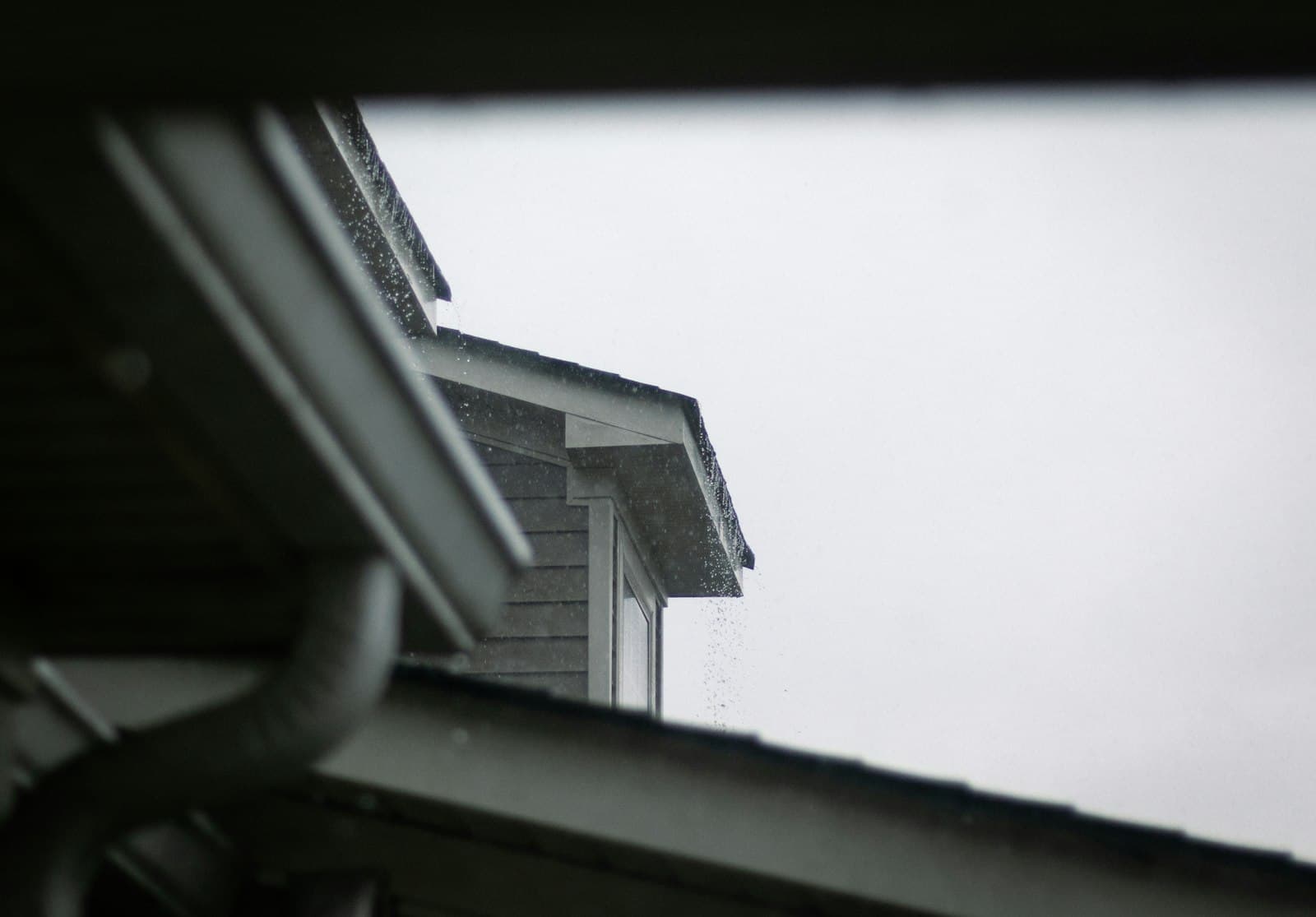
A surprising share of wet cellars in the region are dry within a season once the water on the surface is sent somewhere else. Snowmelt off the hill behind a house in Westfield or Southwick, a downspout dumping beside the foundation in Easthampton, or a flower bed sloped toward the wall all put water exactly where you do not want it.
Before you sign for a perimeter drain, ask the contractor whether they have looked at the outside. A fair one will check:
- Whether gutters overflow and where every downspout empties.
- Whether the soil within a few feet of the foundation slopes away from the house.
- Whether a driveway or patio sends runoff toward the wall.
- Whether window wells fill in a storm.
Fixing those can cost a few hundred dollars. If a contractor quotes a full interior system without mentioning any of them, ask why, and consider fixing the outside first and watching the cellar through a spring before spending five figures.
Interior drains, sump pumps and backup power for hill towns
Most waterproofing in the region is interior: a perimeter drain cut into the slab along the walls, a membrane against the wall to guide water down, and a sump pump to send it out. In the hill towns, where many houses are on wells, the same storms that raise water in the cellar often knock out power. A sump pump without backup does nothing in a blackout. Ask about:
- Battery backup or a water-powered backup pump (on a well, water-powered may not work without power).
- An alarm that alerts your phone if the water rises.
- Where the discharge line runs, so it does not freeze in January.
The NWS Boston/Norton office issues flood watches for the valley; when one is posted, test the pump.
Radon when the cellar is opened up
Cutting a perimeter drain or opening a sump creates a new path for soil gas into the house. EPA's Massachusetts radon zone map covers every county, and the agency advises testing every home regardless of zone. A sealed sump lid and a radon test after the job are simple additions. Ask the contractor whether the sump will be sealed and whether they can add a radon fan if a test calls for one.
Registration, structure and the contract
Cellar waterproofing for an owner living in a one- to four-family house counts as home improvement under state law; the company has to carry an HIC registration, which you can confirm on the Contractor Hub. If the job includes rebuilding a section of foundation, bracing a bowing wall or underpinning, that is structural and needs a licensed construction supervisor, per the state's CSL page.
Above $1,000, the contract must be in writing under c.142A §2, listing the work, the dates, the payments and the registration number, and the deposit is held to a third of the job unless specially ordered materials cost more. Waterproofing materials are rarely special-order. Lifetime warranties are common in this trade; read what they cover and whether they transfer to a buyer. If a registered contractor fails you and does not pay a judgment or award, the Guaranty Fund can step in.
Comparing bids between $7,000 and $13,800
The Western Massachusetts calculator puts a typical job at about $7,000 to $13,800, and the waterproofing cost estimate for this market refines it. Line up the linear feet of drain, the pump model and backup, the discharge route, any wall repair, and the warranty terms. In Holyoke or Pittsfield, where the contractor can see a dozen similar cellars in a day, ask what they found on your street.