A handyman fills the space between doing it yourself and hiring a contractor: a sticking door, a loose railing, a leaking faucet, a list of small things before a sale or a new tenant. In Greater Providence, that list is often long. The housing is old, much of it is rental, and landlords in Providence, Pawtucket and Cranston keep handymen busy between leases. Rhode Island's rules for this kind of work are stricter than many homeowners expect.
The $500 line in Rhode Island's contractor law
Rhode Island has no handyman license, but it does not leave small-job workers out of the contractor registration law either. The exemptions in RIGL 5-65-2 cover a person working on one structure or project when the total of all their contracts is under $500 and the work is "casual, minor, or inconsequential." The exemption ends the moment that person advertises, puts out a sign or card, or otherwise presents as a contractor.
So in practice:
- A neighbor who fixes a gate for $150 and does not advertise is exempt.
- A handyman with a truck sign, a website or a listing online is expected to be registered, whatever the job's size.
- A list of small tasks that adds up to more than $500 on one property is not minor work.
Look up the registration on the CRLB contractor search. Registered handymen carry the insurance the law requires, $500,000 in liability plus workers' compensation under RIGL 5-65-7. That is the part that matters most if someone falls off a ladder in your stairwell.
What a handyman should not touch: wiring, plumbing and gas
The Department of Labor and Training licenses electricians, plumbers and mechanical trades, and a handyman who does not hold one of those licenses should stay out of that work. You can check any trade license on the DLT license search.
Usually inside a handyman's lane:
- a new cartridge in a dripping faucet, a running toilet's flapper, a shower head;
- patching drywall or plaster, hanging doors, fixing trim;
- assembling furniture, mounting TVs on existing outlets, installing shelves;
- caulking, weatherstripping, small exterior repairs at ground level.
Call a licensed tradesperson for:
- new circuits, new outlets or moving outlets, panel work;
- moving or adding plumbing fixtures, water heaters, anything on the gas line;
- anything that needs a permit and an inspection.
A handyman who offers to "take care of the electrical too" on a bathroom refresh in North Providence or Johnston is offering to do work they are not licensed for, and the permit, if any is pulled, will not be in their name.
Porches, stairs and railings on multifamily houses
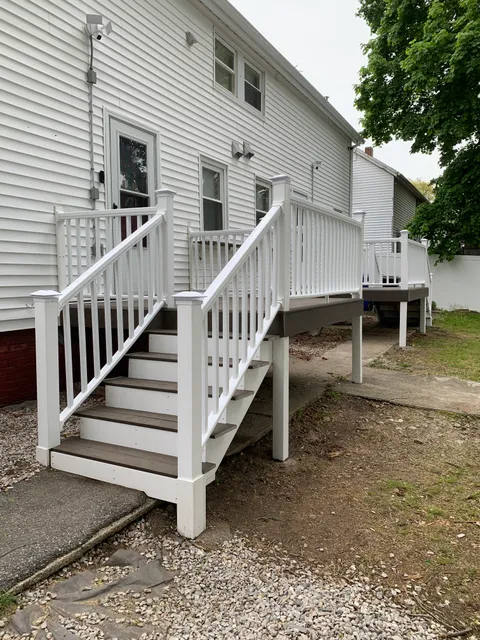
Triple-deckers and two-families in Providence, Pawtucket, Central Falls and Woonsocket carry stacked back porches and long exterior stairs, and they are some of the most common handyman calls in the cities. A loose baluster or a split stair tread is a handyman repair. Rotted posts, a porch that has started to lean, or a railing that moves when you push on it is something else.
Where the line falls:
- Repair: replacing a few boards, a tread, a section of railing with the same thing, painting.
- Rebuild: new posts, new framing, new footings, or replacing a whole porch level. That is structural carpentry, it normally needs a building permit, and it should be done by a registered contractor who pulls one.
Porches carry people three stories up. If a handyman finds rot in the structure while doing a small repair, ask for photos and a written note, and bring in a carpenter or contractor for the structural part. Landlords should take this seriously: an exterior stair is where a tenant's fall turns into a lawsuit.
Turnover work in rental units
Many handyman calls in this market come from landlords. Two-family and three-family houses in the cities turn over around leases, and in the student neighborhoods near the city's colleges, or around URI's Kingston campus in South Kingstown, the timing can be tight. A good turnover handyman can patch, paint touch-ups, rehang doors and fix fixtures in a few days.
On a pre-1978 rental, though, patching and sanding painted walls and trim is lead work. Federal rules require certified firms for paid work that disturbs paint in those homes, and Rhode Island's lead law for rentals adds the landlord's own duties. Ask the handyman whether they are lead-certified before they sand a windowsill in a Providence apartment built in 1920.
Shore houses and the opening-and-closing list
Seasonal homes in Narragansett, Middletown and Newport generate their own handyman work: opening the house in spring, closing it in fall, fixing what a winter storm loosened, and preparing for renters. If you are hiring someone to check on a closed house:
- Agree in writing what each visit includes.
- Leave contact details for a licensed plumber and electrician they can call.
- Decide in advance how much they may spend on a repair without asking you.
Fall River, New Bedford and Somerset: Massachusetts rules
The market crosses the state line, and the South Coast works under Massachusetts law. There, a contractor working on an existing one-to-four-unit house where the owner lives must hold a home improvement contractor registration under MGL c.142A §9. Check the name on the Massachusetts Contractor Hub. A Rhode Island registration does not count in Fall River, and a Massachusetts one does not count in Tiverton.
Getting a fair price and a clean bill
The Greater Providence calculator puts a typical handyman visit at about $200 to $790; enter your task list on the handyman cost estimate for this market. A few hours of repairs in a Warwick ranch sits at the bottom. A full day of turnover work across three units in East Providence will sit near the top or above.
Before the visit, write a single list of everything you want done, with photos of each item. A handyman who sees the whole list can bring the right materials and quote properly. After the visit, ask for an itemized bill: tasks, hours, materials. It helps if something comes loose next month, and it is the record you need for a rental property's expenses.
Good handymen in this market book up weeks ahead in spring and before the start of the school year, when rentals change hands. If your list is not urgent, call in winter. Ask whether there is a minimum charge, often a half day, and whether driving time to a far corner of the market, such as Burrillville or Charlestown, is billed. Combining small jobs into one visit is usually cheaper than calling three times. And if one item on the list turns out to need a permit or a licensed trade, it is better to hear that from the handyman on the first visit than to find out from an inspector or a buyer years later.