No state leans on heating oil the way Maine does. The Governor's Energy Office, citing federal data, calls it "the most heating oil dependent state for home heating in the nation," with 52% of households burning fuel oil as their main heat. Propane, wood, electricity and pipeline gas split the rest, and gas mains reach only the bigger towns. So an HVAC call in Maine is rarely just about comfort. It is usually about what you burn, what it costs this winter, and whether to keep burning it.
Which Maine license matters for the equipment you have?
Maine does not license a general "HVAC contractor." What it licenses is the person who touches fuel. The Maine Fuel Board issues master and journeyman licenses for oil and solid-fuel technicians, and a separate Propane and Natural Gas Technician license. A boiler cleaning in Brewer, a furnace replacement in Sanford or a propane line to a new range in Bath is Fuel Board work, and the technician's own name should come up on the state's ALMS search.
Heat pumps are different. An installer who sets only heat pumps holds no state HVAC license, and the electrical connection belongs to a licensed electrician. For heat pumps the credential that actually matters to your wallet is a program listing: to collect a rebate, the installer must be an Efficiency Maine Residential Registered Vendor.
So ask two questions on every quote. Who holds the Fuel Board license, if any fuel equipment is touched? Is the company a Registered Vendor, if a rebate is in the math?
How do Efficiency Maine's 2026 rebates add up?
Efficiency Maine's rebate page sets the 2026 whole-home amounts per rebate-eligible outdoor unit:
- $3,000 per unit for low-income households (MaineCare, HEAP, SNAP or TANF)
- $2,000 for moderate income (adjusted gross income up to $70,000 single or $100,000 joint)
- $1,000 for any income
Lifetime limits per housing unit are $9,000, $6,000 and $3,000. A ducted whole-home system can earn the same $9,000 / $6,000 / $3,000 amounts. The conditions are where people trip:
- The heat pumps must be the primary heat. A boiler or furnace may stay, but only as emergency backup.
- Only single-zone units earn a rebate. Multi-zone capacity counts toward sizing the house but isn't rebatable, and dual-fuel systems aren't eligible. The heat pump FAQ covers these rules.
- The claim is due within six months of the install.
There is also a $500 limited-time bonus per housing unit for whole-home upgrades completed and claimed between March 1 and December 31, 2026 (whole-home page). A low-income household's first single-zone heat pump can carry a separate $3,000 supplemental rebate.
When an installer quotes a multi-zone system, ask for a single-zone alternative priced next to it. The rebate gap can be larger than the equipment savings.
What do the numbers look like for a real house?
The Maine calculator default for a typical HVAC job is about $4,500 to $10,300, and the Maine HVAC cost estimate breaks it down. Efficiency Maine publishes its own worked example on its heat pumps page: two indoor units installed for $10,000, netting $4,000, $6,000 or $8,000 after rebates by income tier. Its operating-cost assumptions, as of September 2026, are propane at $3.20 a gallon and electricity at 26 cents a kilowatt-hour.
Compare that with what you pay now. The Energy Office's weekly fuel survey put statewide retail heating oil at $6.05 a gallon on October 26, 2026, with a low of $5.50 and a high of $6.81, and propane at $3.57. The survey runs September through April. Ask an installer to show you the running-cost comparison using current prices, not last year's.
Will heat pumps carry a house through an Aroostook January?
This is the question people in Fort Kent, Madawaska and Presque Isle ask first, and it's the reason the whole-home rebate allows the old boiler to stay as a backup. What decides the answer is less the climate than the house: how tight it is, how many rooms a single head can reach, and whether the doors stay open. A good installer does a room-by-room load estimate before naming a number of heads, and tells you which rooms will lean on the backup.
Ask how the controls will be set. If the boiler thermostat sits a few degrees below the heat pumps, the oil only runs when the heat pumps can't keep up. If it's set the same or higher, the boiler quietly does most of the work, and both your rebate condition and your savings suffer.
How do you compare two heat pump quotes line by line?
Heat pump quotes in Maine vary more than most HVAC prices, partly because two installers can propose very different systems for the same house. Before you compare totals, line them up on the same points:
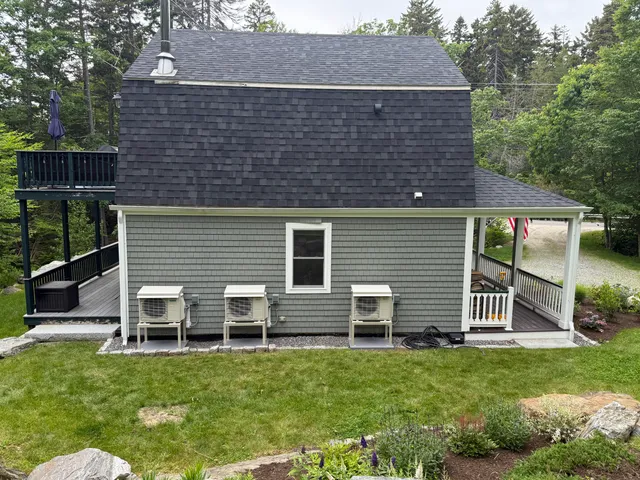
- Number and type of outdoor units. Three single-zone units and one three-zone unit can heat the same rooms but land in very different rebate positions.
- Indoor head placement. Ask for a sketch. A head high on a living-room wall in a Lewiston cape may never reach the bedrooms upstairs.
- Line-set routing and covers. Exposed line sets on the street side of an older house in Hallowell or Portland look raw, and in a local historic district the change may need review; covers and longer routing cost extra.
- Electrical. Whose electrician, and is a panel change included?
- Snow and ice. In a snowbelt town the outdoor unit needs a stand or wall bracket that keeps it above drifting snow and out from under a roof edge that sheds ice.
- Controls and backup. How the old system is set to run second.
- Paperwork. Who files the rebate claim, and by when.
Ask each installer to name the indoor temperature and outdoor design temperature they sized to. If one sized for a mild winter and the other for a hard one, their prices aren't comparable.
Does a new house built in 2027 get the same rebate?
Not on the same terms. Efficiency Maine's 2026 page says new construction completed on or after January 1, 2027 must have no furnace or boiler at all to qualify. If you are building in Scarborough or Brunswick and the house won't be finished until next year, plan the heating system with that in mind now, and ask your builder which rebate rules the HVAC price assumes.
What about switching oil to gas, or keeping the boiler tuned?
If you live where gas mains run, in parts of Greater Portland, Lewiston, Augusta or Bangor, a fuel switch is another route. The Fuel Board's consumer questions page says an oil appliance can be converted safely to natural gas by a licensed technician using a conversion unit designed for that change, and it tells homeowners to start by calling the local gas supplier.
If you are keeping oil, the annual service is the job that matters most. Boiler and furnace tune-ups crowd into early fall as the heating season starts, so book in summer if you can.
How should a mid-job change be handled?
Heat pump jobs often change once the installer opens a wall or finds the panel is full. Under Maine's change-order section, a change that alters the price on a contract covered by the Home Construction Contracts Act has to be written, signed by both parties, and show the old and new price. An extra head, a line-set reroute or an electrical upgrade added on the day should come with that paper before the work, not on the final bill.