Maine's painted houses are mostly wood, and many are old. Clapboard capes, Greek Revival farmhouses, shingled cottages on the coast at Cape Elizabeth and Camden, and the wood multi-families of Biddeford and Waterville all carry decades of paint layers. Hiring a painter here is less about the color and more about two practical questions: what is in the old paint, and can the job be done before the weather closes in?
Is there a license to look for?
No. The Attorney General's office confirms that most building trades in Maine are unlicensed, and painting is among them. There is no state number to search. What you can check is insurance (a certificate made out to you), the crew's experience with older houses, and how they handle lead, which is the only area where state and federal rules reach into a paint job.
Who can tell you whether the old paint contains lead?
Maine DEP's lead program gives the scale of the problem: it believes over half of Maine's homes may hold lead-based paint, and it puts the greatest risk in houses from before 1950, with any pre-1978 renovation a concern (Maine DEP lead). For a painter, scraping and sanding are the work that turns old paint into dust.
If you want an answer before work begins, DEP's find a lead professional page lists licensed lead inspectors and risk assessors. An inspection tells you which surfaces carry lead and lets you and the painter plan containment for those surfaces, rather than guessing. On a house in South Portland or Rockland with known old layers, many painters simply treat every surface as lead-bearing, which is also a reasonable approach.
If you rent units out, lead matters for the tenants as well. DEP rates rentals as "Lead Maintained," "Lead Safe" or "Lead-based Paint Free," and those ratings appear on MaineHousingSearch through its healthy rental housing program. A paint job that leaves chips in the soil around the building works against you there.
What should lead-safe prep look like on your house?
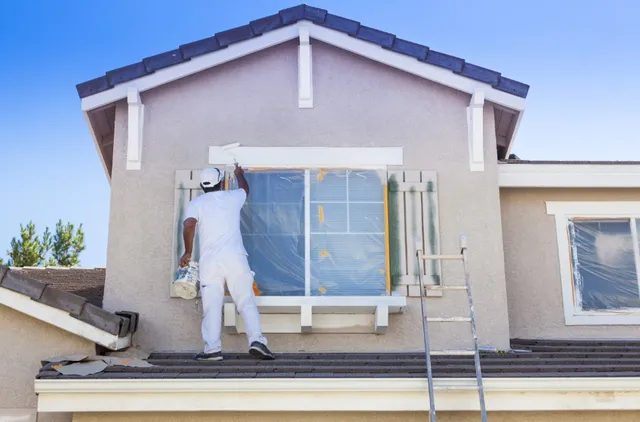
Federal renovation rules require lead-safe work practices on pre-1978 homes. On an exterior job, that should mean, at least:
- plastic sheeting on the ground, extending several feet out from the wall and weighted down
- windows and doors closed and covered near the work area
- no open-flame burning of paint and no power sanding without a vacuum attachment
- daily cleanup of chips and debris, bagged, not swept into the lawn
- a final cleanup and a look at the soil line before the crew leaves
Inside, the containment is tighter: rooms sealed, furniture covered or removed, floors protected, and a careful wet cleanup at the end.
Ask each bidder to explain their method in their own words. "We follow the rules" is not an answer. A painter who describes sheeting, misting, HEPA vacuums and disposal has probably done it before.
Why does a Maine paint job cost as much as one in Boston?
You might expect a paint job in Bangor or Ellsworth to cost noticeably less than one outside Boston. The Maine calculator default for a typical painting job is about $6,000 to $9,000, the same as Greater Boston's. The reason is labor. The calculator scales each trade by federal wage data for the Portland area and the state, and Maine painters' wages came in at or above Boston's, so no discount was applied. The Maine painting cost estimate shows the default and what sits behind it.
What changes the price is the house. Staging on a three-story Victorian, heavy scraping, replacing rotten clapboards and trim, lead-safe containment and multiple colors all add cost. A one-story ranch with sound paint and simple trim comes in under the default.
How does a short season change your timing?
Exterior paint needs dry wood and temperatures inside the product's range, both day and night. In Maine that confines exterior work to roughly late spring through early fall, and the window is shorter in Houlton or the western mountains than on the coast. Painters in Saco, Skowhegan or Thomaston often fill their exterior calendar by March.
Interior painting is the opposite. Winter is when many crews look for indoor work. If you have both kinds of painting to do, ask whether a painter will give a better schedule, or a better price, for doing the inside in February and the outside in June.
How can you judge a painter's prep before you hire them?
Prep is most of a good exterior job and nearly invisible once the last coat is on. Finished work in photos tells you little. A few better ways to judge:
- Visit a job in progress. Ask a painter where they are working this week and drive by. Look at the ground sheeting, the scraped surfaces and how the site is left at the end of the day.
- Look at a job that is five years old. Peeling at the bottom of clapboards, failing paint on window sills and bare wood on the south side show up within a few winters if prep was skipped.
- Ask what they will not paint over. A painter who says they will replace or epoxy rotten sills, rather than fill and paint them, is protecting their own warranty.
- Ask about moisture. Paint that blisters on an old Maine house often points to moisture moving out through the wall, from a bathroom or kitchen without good ventilation. A painter who asks what's on the other side of a blistered wall is thinking about the cause.
Get at least two written quotes that describe the prep the same way, so you are comparing like with like.
What belongs in a painting contract?
A paint job over $3,000 is the kind of home repair Maine's Home Construction Contracts Act covers. The Act's core rule (10 M.R.S. §1487) is that such a contract is written, signed by both sides, and handed to each of you before the work starts, and that the payment terms don't ask for more than one-third at the outset. The contract should also name:
- every surface to be painted, and those not included
- the prep: scraping, sanding, priming bare wood, caulking, glazing
- the paint brand and product line, the sheen, and the number of coats
- carpentry repairs, priced per board or per foot
- the lead-safe method, in words
- estimated start and completion dates
Painters often find rotten wood once scraping begins. If replacing it changes the price, Maine law requires a written change order, signed by both of you, that states the price before and after (10 M.R.S. §1488). Agreeing on a per-board price in the contract makes that quick.
Finally, ask how long the painter stands behind the work. Peeling within two or three years on a well-prepped surface is usually a prep problem, and a good painter will say up front what they'll come back to fix.