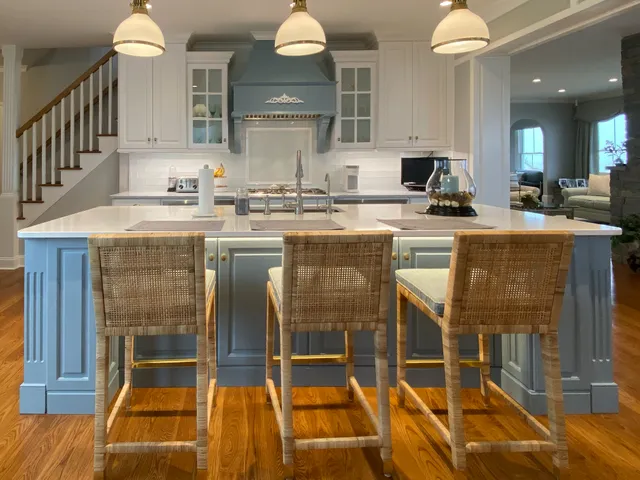
A kitchen is the remodel where the most trades meet in the smallest room. Cabinets, counters, flooring and drywall are home improvement work. The sink and dishwasher are plumbing. The range circuit, the lighting and the new outlets are electrical. A gas range or cooktop brings gas piping into it. Connecticut regulates each of those pieces separately, and a good kitchen remodeler will have the right person on each one.
Who touches what in a Connecticut kitchen
Start with the company you sign with. The firm selling you the kitchen must be registered with the state's consumer protection department as a Home Improvement Contractor. The Home Improvement Act reaches any job on a residence priced above $200 (CGS chapter 400), which takes in every kitchen.
Then the trades:
- Plumbing for the sink, dishwasher, ice maker and any relocated drain: a licensed plumber, P-1 for the contractor.
- Electrical for new circuits, lighting and appliance feeds: a licensed electrician, usually an E-1.
- Gas for a range, cooktop or wall oven: piping is licensed trade work too. Ask which license the person running your gas line holds.
Every one of these can be checked on eLicense. DCP's page on which license a contractor needs explains how the two systems fit together: home improvement registration doesn't stretch to cover licensed trade work, so a remodeler without plumbing and electrical licenses will bring in subcontractors who have them. Ask for their names before you sign, and check that the people who show up match.
Why Gold Coast kitchen quotes track Westchester
Connecticut is one pricing market, but kitchens show the spread inside it more than most jobs. In Greenwich, Darien, Westport and Fairfield, the commuter towns strung along the New Haven Line to Grand Central (CTrail), contractors and their suppliers price against New York's suburbs. Stamford and Norwalk sit in the same orbit. A kitchen quote there often lands at the top of the state's range or above it.
Up the line in Branford and Madison, inland in Glastonbury or West Hartford, and further east and north, the same kitchen often comes in lower. That isn't a reason to hire across the state to save money: a crew two hours away will charge for travel or won't come back for the punch list. It is a reason to know where your quotes should sit for your own town.
A change order for every cabinet swap
Kitchens change halfway through more than any other room. A cabinet line is discontinued, the counter fabricator's template shows a wall that's out of square, or you decide you want the island after all. Under the Home Improvement Act, every change to a home improvement contract must be in writing and signed by both sides (Sec. 20-429).
Make the change order do real work:
- describe the change in plain words, with the product and model;
- give the added or reduced price;
- say how it moves the completion date.
The original contract must already carry a start date and a completion date, the remodeler's registration number and your cancellation rights, and must be signed and dated. When the change orders add up, the completion date written in them is the one you can hold the remodeler to.
Timing the permit around the cabinet delivery
Kitchen remodels that move plumbing, wiring or walls need a building permit from the town, and the inspections fall at awkward moments: rough plumbing and electrical must be inspected before the walls are closed, and before cabinets go in. DCP's guidance on working with a contractor says to agree in writing on who pulls the permit, because it's ultimately the homeowner's responsibility.
Ask the remodeler to lay out the sequence: demolition, rough-ins, inspection, insulation, drywall, cabinets, counters, final inspection. Cabinets arriving before the rough inspection passes is a common source of delay and storage fees.
Lead dust in an older kitchen
Kitchens in Connecticut's prewar city housing, from Hartford and New Britain to New Haven and Bridgeport, often hide several layers of old paint under later cabinets and trim. In any house built before 1978, demolition is treated as disturbing lead paint. The Department of Public Health's homeowner page lists the precautions, and the firm doing the work must be EPA lead-safe certified. Ask how the kitchen will be sealed from the rest of the house, especially if food will be prepared in a temporary kitchen nearby.
If the deposit disappears with the contractor
Connecticut doesn't cap deposits in law. DCP advises keeping the first payment to no more than about a third of the job and spreading the rest over three or four stages, and not paying cash. On a kitchen, a sensible pattern is a payment at signing, one when cabinets are delivered and inspected, one when counters are installed, and the last after final inspection.
If a registered contractor takes a deposit and vanishes, the Home Improvement Guaranty Fund is a backstop, not a shortcut. You first need a court judgment or an arbitration award confirmed by a court. A Superior Court judgment also needs a marshal's failed attempt to collect; a small claims judgment doesn't. You then apply within two years, and the fund pays up to $25,000. DCP says most qualified applicants are paid within about 24 weeks. The fund only covers contractors who were registered, which is the strongest reason to look the remodeler up before you pay anything.
Cabinets, counters and layout in Connecticut houses
The state's housing shapes kitchen work in predictable ways:
- Postwar capes and ranches in Newington, Trumbull and Stratford have small, closed kitchens. Opening a wall to the dining room is common and may involve a beam.
- Colonials in Glastonbury, Fairfield and Ridgefield often have room for an island but need the floor plan redrawn to fit one.
- City two- and three-families in Waterbury and New Britain have narrow kitchens stacked over each other, so plumbing runs through the unit below.
- Antique farmhouses in Ellington, Lebanon or the Litchfield Hills have floors that aren't level and walls that aren't square, which a cabinet installer has to shim and scribe around.
Living without a kitchen for a few weeks
Most families stay in the house during a kitchen remodel, so plan the temporary setup before demolition day. Ask the remodeler:
- Which day the water and gas to the kitchen will be shut off, and for how long.
- Whether the refrigerator can stay plugged in somewhere else in the house.
- Where the dumpster and the cabinet delivery will go, especially on a narrow city lot or a shared driveway.
- What stops drywall dust from drifting into the living room, and who sweeps up each evening.
- What hours the crew works, and whether anyone will be on site on days with no visible progress.
A remodeler who has a ready answer to each of these has done it many times. One who doesn't will learn on your job.
Kitchen budgets where cabinets and layout decide the number
A typical kitchen remodel in Connecticut runs $21,600 to $32,900, the state calculator's default. Adjust for your size and finishes on the Connecticut kitchen remodel cost page, and expect Fairfield County quotes toward the top.