Connecticut's heating map splits in two. Gas mains serve the cities: utility gas heats about 57% of homes in Greater Bridgeport and nearly half in the New Haven and Capitol regions. Step out of the cities and oil takes over. Six in ten homes in the Northeastern region burn oil, as do more than half in the Northwest Hills and in the Lower Connecticut River Valley. Statewide the two fuels run neck and neck, at about 36% gas and 35% oil. Which side of that line your house sits on decides most of what an HVAC contractor will propose.
Which DCP license covers the work in your basement
Heating and cooling in Connecticut is state-licensed work, overseen by DCP's Heating, Piping, Cooling and Sheet Metal Work Board. The class codes are set out in CGS chapter 393:
- S-1 / S-2 cover heating, piping and cooling. The S-1 is the contractor; the S-2 is the journeyman.
- D-1 / D-2 are a limited heating and cooling class. Ask what work the license allows before relying on it for your job.
- Sheet metal has its own license. New or altered ductwork belongs to a sheet-metal license holder.
- Gas hearth. A gas fireplace, log set or stove insert needs a separate gas-hearth license under the Home Improvement Act, Sec. 20-420(d).
Every one of these shows on DCP's eLicense lookup. A heat pump job often touches three trades at once: the HVAC license for the equipment, the sheet-metal license for any ducts, and an electrician for the circuit. DCP's page on which other license a contractor needs links the scope booklets if you want the detail.
Replacing an oil boiler in Putnam, Litchfield or Old Lyme
Out in oil country, the decision is no longer only "new boiler or not". Owners in Putnam, Woodstock and Thompson, in Litchfield and Salisbury, and along the river in East Haddam and Old Lyme usually choose between three paths:
- A like-for-like oil boiler or furnace. Lowest up-front cost, keeps the tank and the delivery bill.
- A heat pump that carries most of the load, with oil as backup. The boiler stays for the coldest nights.
- A whole-home heat pump system. The oil system comes out, often along with the tank.
Ask any contractor quoting option 2 or 3 for a room-by-room heat-loss calculation, not a rule of thumb per square foot. A 19th-century farmhouse with plaster walls and no wall insulation loses heat in a very different pattern from a 1990s colonial in Simsbury. Equipment sized to the wrong number short-cycles in the shoulder seasons and struggles in January.
The $40 Home Energy Solutions visit, and why it comes first
Energize CT, the efficiency program funded by the state's utility customers, runs the Home Energy Solutions assessment. Eversource's program page puts the copay at $40 since April 1, 2026, and says participants receive on average about $1,000 in products and services, with $70 to $100 a year in savings. A home qualifies if it hasn't had the service in six years, and larger or older homes (over 2,000 square feet, or built before 1985) can have the work split into two visits.
The assessment matters for HVAC because air sealing and insulation shrink the equipment you need. A smaller heat pump costs less to buy and runs more efficiently.
What Energize CT pays toward a heat pump
Energize CT's heat pump page describes per-ton rebates for qualifying systems, with a larger amount for whole-home installs than for supplemental ones. The whole-home tier has carried conditions: a whole-home heating design, cold-climate rated equipment, an installer registered with the program, and a completed Home Energy Solutions assessment. The dollar figures and date windows change during the year, so read the current page and ask the contractor to show the rebate in writing on the quote, as a separate line from the price.
Who removes a buried oil tank
Many conversions end with a tank to remove. A buried residential tank is a special case under the Home Improvement Act. A contractor can't register for that work until it has completed hazardous materials training approved by the Department of Energy and Environmental Protection and shows $1 million in liability coverage (Sec. 20-420(a)).
Before you sign for tank work:
- Ask for the registration on eLicense and a certificate of insurance at that level.
- Ask what happens if the soil under the tank is contaminated, who tests it, and how that would be priced.
- Keep the closure and disposal paperwork. A buyer's lender or insurer may ask for it.
A tank sitting in the basement falls outside that underground-tank rule, but ask the same questions about disposal and paperwork.
Gas cities: Bridgeport, Stratford and Hartford
In the gas-served cities the questions are different. A Bridgeport or Stratford owner with a 30-year-old gas furnace might weigh a high-efficiency replacement against a heat pump with gas backup. In Hartford's two- and three-families, each unit often has its own boiler or furnace in a shared basement, and venting a new high-efficiency unit through an old masonry chimney or out a side wall has to be solved for each one.
Ask the contractor how they'll vent the new unit and whether the chimney needs a liner. That is often the line that separates two quotes that look alike.
Ductless heads in a house that never had ducts
Most of the state's older housing was built around a boiler and radiators, so there are no ducts to reuse. Capes and ranches in Hamden, Wethersfield or Groton, and antique farmhouses up in the hills, often end up with ductless mini-split heads instead, and that brings its own list of questions:
- How many heads, and where. One head per open area is common; closed-off bedrooms may each need their own, or a small ducted unit in the attic.
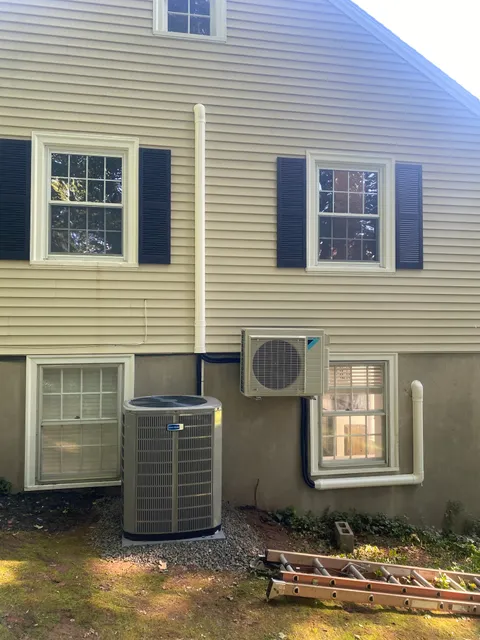
- Where the line sets run. On the outside wall, in a cover, or inside through closets. The answer changes both the look and the price.
- Where the outdoor unit sits. It needs to stay above the snow line and clear of a roof edge that drops ice.
- What happens to the radiators. Many owners keep the boiler as backup for the first winter. Ask whether the contractor will service both systems.
Booking around the heating season
Fall is the crunch. Tune-ups, no-heat calls and tank deliveries all pile up between October and the first hard freeze, and installers who do conversions book out with them. If you're planning a replacement rather than reacting to a failure, get assessments and quotes in late spring or summer, when crews have time to measure the house properly.
Lining up heat pump and boiler quotes before you compare them
The calculator default for a typical HVAC project here is $4,700 to $10,700, on a state factor of about 94% of Greater Boston. Run your own system and house size on the Connecticut HVAC cost page. Fairfield County quotes tend to run higher and eastern and northwestern towns lower.
Before you compare quotes, make sure each one names the equipment model and its rated capacity, the heat-loss method used, the licenses involved, the permit, and any rebate counted in the price. Two contractors quoting "a heat pump" may be quoting very different systems.