Two of every three homes in Connecticut were built before 1980, and one in five before 1940. In Greater Bridgeport the median house dates from 1959. For a painter, that means almost every exterior job in Bridgeport, Stratford or Norwalk, and most in the older parts of Hamden, Meriden and New London, involves lead paint somewhere under the newer coats. How a painter handles that is the most important thing to ask about.
Painters are home improvement contractors here
Connecticut has no separate painting license. What it does have is the Home Improvement Act, and the Department of Consumer Protection counts residential painting as home improvement work. A painting company needs a Home Improvement Contractor registration, as DCP's registration page explains, and you can find it by searching the company or owner on eLicense.
The registration requires the company to carry at least $20,000 in general liability insurance. Ask for a certificate sent to you directly by the insurer, naming you as certificate holder, because ladders and staging on a three-story Victorian are where accidents happen. If the painter has employees, ask about workers' compensation too.
Lead-safe prep on a house built before 1978
A house built before 1978 should be treated as having lead paint until a test says otherwise. Two layers of rules apply.
The federal rule. Paid work that disturbs paint in a pre-1978 home has to be done by a firm holding certification from EPA's Renovation, Repair and Painting program, and must follow lead-safe work practices: plastic sheeting under the work, containment of chips and dust, specific cleanup and verification at the end. Ask to see the firm certificate, and find out which crew member holds the individual renovator training.
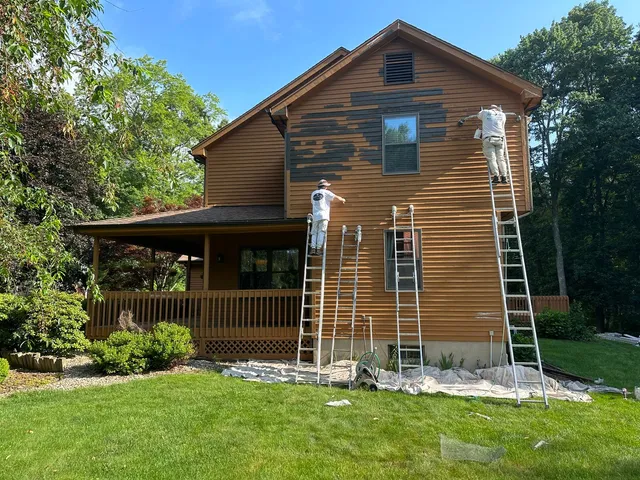
The state's advice. Connecticut's Department of Public Health tells homeowners not to dry scrape old paint and not to power-wash pre-1978 paint, and notes that some towns ban those methods. Power-washing is the one to watch: it's fast and cheap, and it blasts paint chips across the yard, into garden beds and onto the neighbor's property.
Removing lead permanently, rather than painting over it safely, is a different trade. Lead abatement contractors are licensed separately by DPH, as its page for professionals explains. If a child in the home has an elevated blood lead level, the local health director gets involved: since January 1, 2025, Connecticut law requires an investigation at 5 micrograms per deciliter and up (CGS Sec. 19a-111).
Questions for the painter about prep
Most of the price of exterior painting is preparation, and most of the difference between two quotes is how much prep each one includes. Ask:
- How will loose paint be removed: hand scraping with misting, wet sanding, or a HEPA-vacuum sander?
- What happens to the debris, and how is the ground protected?
- Which boards and trim will be replaced, and how is rotten wood priced?
- Will bare wood be primed, and with what?
- How many coats of finish, and what product line?
- Are windows and sashes included, and will they be painted shut?
- Who takes down and rehangs shutters, storm windows, house numbers and light fixtures?
- How will shrubs, decks and the driveway be protected from drips and debris?
Get the answers in writing. A low quote with "scrape and paint" as the whole scope usually means less prep, not a better price for the same job.
Peeling that comes back: find the moisture first
Paint that peels to bare wood within a few years of a paint job is rarely the paint's fault. On Connecticut houses the usual causes are water getting behind the siding, from a leaking gutter, a missing piece of flashing over a window, or an ice dam at the eaves, and moisture moving outward from a bathroom or kitchen with no exhaust fan. A painter who only scrapes and recoats the same wall will be back in two years.
Ask the painter to walk the house and point out where the paint is failing worst. If the pattern follows the gutters, the bathroom wall or the bottom courses near the ground, the fix starts with a gutter contractor, a carpenter or a ventilation change, not another coat. A careful painter will tell you that even though it shrinks their job, and will often suggest the order to do things in.
The same goes for cedar shingles and clapboards on shoreline cottages. Stain or paint on wood that never dries out won't last, so ask about ventilation behind the siding before choosing a finish.
Interiors in older city homes
Inside, the issues are plaster and trim. In a 1920s two-family in Hamden or a farmhouse in Litchfield or Thomaston, plaster cracks, layers of old paint on window and door trim, and painted-shut sashes are common. Lead-safe rules apply indoors too: containment, no dry sanding, and a careful cleanup, especially in homes with young children.
For an interior job, ask how furniture and floors will be protected, how the rooms will be cleaned at the end of each day, and whether the painter patches plaster cracks or only fills them.
Paying in stages, not up front
Connecticut doesn't set a legal limit on deposits. DCP's guidance is that a down payment generally shouldn't exceed a third of the project, that the balance should come in three or four payments tied to progress, and that you shouldn't pay cash.
For an exterior, a fair split is: a deposit to secure the date and buy paint, a payment when prep and priming are done and you've inspected them, and the balance after the final coat and your walk-around with the painter. Hold the last payment until touch-ups are finished and the ground has been cleaned.
The contract must be in writing and signed by both sides, carry the painter's registration number, and name a start date and a completion date. Because weather delays painting, ask the painter to write in how rain days will affect the completion date.
Shoreline paint and hill-town paint
Salt air and sun along the shore in Fairfield, New Canaan, Waterford and Old Lyme break down paint faster on south- and water-facing walls. Inland, in Enfield, Suffield and up into the Litchfield Hills, moisture from snow and ice at the bottom courses of clapboards is the bigger problem. A good painter will look at where the paint is failing on your house and explain why before quoting.
Why prep, not paint, sets the painting price
Connecticut's calculator puts a typical painting job at $6,050 to $9,100. Try your own house size and scope on the Connecticut painting cost page. Fairfield County, especially the Gold Coast towns, usually costs more, while Wallingford, eastern towns and the Northwest Hills cost less. Old houses with many layers of failing paint can cost much more than the typical range because of the prep.